Nation, politics is a dirty game. It's a blood sport. There's no prize for second place - the winner is the winner, and the loser is exactly that. There are no moral victories, because while you're patting yourself on the back for "doing your best", the victor is putting their policies and plans - which you very likely opposed - into action.
Because of the adversarial nature of the system, then, it's hardly surprising that campaigns often rush to the low ground - attacking the personal background of an opponent, rather than their record or their stated policies.
I wish it didn't work. But it does.
In the Alberta Election of 2019, both the United Conservatives of Jason Kenney and the NDP of Rachel Notley are dialing up the "politics of personal destruction" to 11.
In the case of Kenney's UCP, we have been hearing since before the party even had a full-time leader about the alliance of "Rachel Notley and her close ally/friend/bff Justin Trudeau". I don't think I need to tell you, while New Democrats and Liberals are on the same side of the political bell curve, they're no more obviously allies than the federal Liberals and the Ontario Progressive Conservatives. The fact that they agree sometimes, and smile for photos, doesn't make them friends.
Believe me. Looks at pictures of me and that barbarian Kirk Schmidt.
This, of course, isn't the only example of the UCP and their surrogates tossing labels at the NDP in such rapid succession that it becomes hard to refute them one at a time, because they'd just pile up all over the floor like last week's laundry. The NDP are "an accidental government". A group of Che Guevara fanboys and fangirls. A cadre of Marxists. Anyone who has even breathed the same air as Tzeporah Berman is painted as being an enemy of the energy industry, despite the very public tete-a-tete between the activist and Rachel Notley at a Teacher's Convention event last October. The NDP are without fail referred to as an "ideological government" - as though a UCP government would be any less ideological, in an entirely different direction.
On the other side, the NDP are clearly all-in on attacking Jason Kenney. His past statements and votes as a legislator on issues around same-sex marriage and abortion are under the spotlight, with a 10-minute "documentary" being released by the NDP yesterday, along with a series of websites over the past month or so with the sort of domain names that would make Ezra Levant blush. And while the bulk of their ammunition is being targeted at The Man in the Blue Pick-Up, the New Democrats and their bannermen are also digging up dirt on individual candidates, as seen earlier this week with the revelations of past statements by star UCP candidate Caylan Ford, the blowback from which caused her to resign on the eve of the writ dropping.
Ford's replacement for the UCP in the riding, Jeremy Wong, has since come under fire for statements he made while serving as a pastor. The statements, while biblically accurate, are certainly causing a stir on-line. But as I've said before: If it doesn't make it into print and the 6 o'clock news, it's not really a thing. Most Albertans who were raised in a Christian home, of any denomination, have been exposed to similar language from the Bible before, and many just walked past it as anachronistic language within a larger narrative. Is it a big deal in 2019? I suspect not, but I've been wrong before - and we still have 25 days to go until the ballots are counted.
At the end of the day, this is seemingly the approach that the NDP and UCP are going to take for the next 3 weeks. Sure, they'll release policies here and there, but overwhelmingly, they're spending their time at the podium talking about their opponents.
They're doing this, because we LET them do it.
We reward this tactic, by electing someone who participated in it.
We reinforce the bad behaviour, and then turn up our noses at how brutish politics can be. And then 4 years later, we reinforce it yet again.
It doesn't HAVE to be this way. But yet we allow it.
And the band plays on...

... an attempt to make sense of politics and political happenings in Calgary, Alberta, Canada, and North America.
Friday, March 22, 2019


Wednesday, March 20, 2019
Poll Dancing
Nation, the first poll of the Alberta 2019 General Election has been released, showing the United Conservative Party of Jason Kenney holding a significant lead over Rachel Notley's NDP overall, at 49% to 38%.
The numbers broken down regionally are somewhat more positive for Notley, as her party holds a commanding 52 to 34 lead in the Capital Region, though those numbers are mirrored in the greater Calgary area, with the UCP holding the edge 54 to 33 over the NDP.
Worth noting, though, are the following caveats:
Consider that in 2015, at this stage in the provincial election, the polls showed the Wildrose Party of Brian Jean ahead in the polls at 31% versus the Prentice PC's at 27% and the Notley NDP at 26%. The final result of that campaign saw the NDP pulling 41% of votes cast, to the PC's 28% and the Wildrose's 24%. In 28 days, the NDP went from third to first, and won a majority government while outperforming that initial poll by 15%.
On a municipal level, four weeks before the 2010 Calgary election, long-time City Councilor Ric McIver led the field with 43% in polls, compared to Barb Higgins at 28% and unknown MRU Professor Naheed Nenshi a distant third at 8%. Once the votes were counted on election day, Nenshi had won the mayor's chair with 40% of votes cast compared to McIver's 32% and Higgins' 26%. In 28 days, Nenshi went from third to first, and won while outperforming that initial poll by 32%.
This is not to suggest that the third-place candidate or party - in the case of the 2019 Alberta election, this is the Alberta Party (polling at 8% province-wide) - is a shoo-in, by any stretch. It simply goes to illustrate the point that the narrative being desperately pushed by both the NDP and the Conservatives, that this is a two-horse race that no one else has a shot at - it just that: a campaign narrative, hoping to steer people away from considering other options.
Of course, on the balance of probabilities, the top 2 finishers in this contest are going to be the NDP and the United Conservatives. 99 times out of a hundred, these sorts of leads in polls are relatively safe, and voters flock to one side in hopes of stopping the other side from winning. That's why both parties are pushing the narrative that this is a two-horse race: Because most of the time, that simple narrative WORKS. Wonks like myself like to delude ourselves into thinking that people will vote for the best policies, or will cast their vote for aspirational reasons, but by far the best motivator is fear.
I fear what four more years of the NDP will do to the economy, so I'm voting Kenney.
I fear what Kenney's party might do to public services and minority rights, so I'm voting NDP.
Can the Alberta Party win this election?
Sure.
I mean, it's possible. They'll have candidates in all 87 constituencies - which is basically a requirement for any party hoping to seriously have a shot at forming government. But a LOT will have to go right for them, and wrong for their opponents, over the next four weeks.
At this stage, I'd put their chances alongside those of my Oilers making the Stanley Cup Playoffs this year.
It's not likely.
But it's POSSIBLE.
But it's going to take a lot of hard work, a lot of people performing at or above the highest level they thought possible, and some significant mis-steps from their opponents.
The numbers broken down regionally are somewhat more positive for Notley, as her party holds a commanding 52 to 34 lead in the Capital Region, though those numbers are mirrored in the greater Calgary area, with the UCP holding the edge 54 to 33 over the NDP.
Worth noting, though, are the following caveats:
- Polls are a snapshot in time, not a predictor of the eventual outcome. If an election were held today, the decided voters were leaning this way, though a full 22% of voters indicated they were undecided.
- An election is not being held today.
- Not everyone votes. Conventional political wisdom suggests that the older you are, the more likely you are to vote - and such groups tend to lean conservative in this province.
- Campaigns matter. They really, REALLY matter.
Consider that in 2015, at this stage in the provincial election, the polls showed the Wildrose Party of Brian Jean ahead in the polls at 31% versus the Prentice PC's at 27% and the Notley NDP at 26%. The final result of that campaign saw the NDP pulling 41% of votes cast, to the PC's 28% and the Wildrose's 24%. In 28 days, the NDP went from third to first, and won a majority government while outperforming that initial poll by 15%.
On a municipal level, four weeks before the 2010 Calgary election, long-time City Councilor Ric McIver led the field with 43% in polls, compared to Barb Higgins at 28% and unknown MRU Professor Naheed Nenshi a distant third at 8%. Once the votes were counted on election day, Nenshi had won the mayor's chair with 40% of votes cast compared to McIver's 32% and Higgins' 26%. In 28 days, Nenshi went from third to first, and won while outperforming that initial poll by 32%.
This is not to suggest that the third-place candidate or party - in the case of the 2019 Alberta election, this is the Alberta Party (polling at 8% province-wide) - is a shoo-in, by any stretch. It simply goes to illustrate the point that the narrative being desperately pushed by both the NDP and the Conservatives, that this is a two-horse race that no one else has a shot at - it just that: a campaign narrative, hoping to steer people away from considering other options.
Of course, on the balance of probabilities, the top 2 finishers in this contest are going to be the NDP and the United Conservatives. 99 times out of a hundred, these sorts of leads in polls are relatively safe, and voters flock to one side in hopes of stopping the other side from winning. That's why both parties are pushing the narrative that this is a two-horse race: Because most of the time, that simple narrative WORKS. Wonks like myself like to delude ourselves into thinking that people will vote for the best policies, or will cast their vote for aspirational reasons, but by far the best motivator is fear.
I fear what four more years of the NDP will do to the economy, so I'm voting Kenney.
I fear what Kenney's party might do to public services and minority rights, so I'm voting NDP.
Can the Alberta Party win this election?
Sure.
I mean, it's possible. They'll have candidates in all 87 constituencies - which is basically a requirement for any party hoping to seriously have a shot at forming government. But a LOT will have to go right for them, and wrong for their opponents, over the next four weeks.
At this stage, I'd put their chances alongside those of my Oilers making the Stanley Cup Playoffs this year.
It's not likely.
But it's POSSIBLE.
But it's going to take a lot of hard work, a lot of people performing at or above the highest level they thought possible, and some significant mis-steps from their opponents.
Tuesday, September 25, 2018
Meet Byel
Nation, allow me to introduce you to Byel
Doromal.
Byel is a family friend – a Philippine national, married, with three
daughters.
Byel first arrived in Canada on New
Year’s Day 2009, sponsored by Tim Horton’s through the Temporary Foreign Worker
program. He worked hard, learning the ropes as he went and helping out whenever
he could. Tim Horton’s liked Byel so much, they kept him on for over 6 years
until a clerical error on their part resulted in his application for another
work permit being denied – while he was in the middle of an application for
Permanent Resident Status.
In December of 2015, as he had been
instructed to do by the federal government, Byel left Canada – the country he
had come to love, and to think of as home.
Almost immediately, Tim Horton’s
engaged an immigration services firm to get Byel back into Canada, and back
into their employ as a Supervisor. He applied for a work permit with his family
included, and they were refused entry due to financial reasons. Heartbroken but
determined to earn a better life for his family, Byel returned to Canada in
late 2017 by himself, with a two year work permit.
Byel has engaged with the Alberta
Nomination for Immigration Program, with renewed hopes of earning Permanent
Resident Status in his new home. In May of 2018, he applied for an Open Visa
for his wife and Student Visas for his three daughters, and was refused again on
all counts due to “lack of financial support”.
The salary which Byel earns from
Tim Horton’s is set as a condition of his Temporary Workers’ Agreement, and cannot
be increased. Likewise, he is not permitted to do any more work to earn extra
money, and he is intent on following these rules. It is sadly ironic that were
Byel not so committed to following the rules and doing things the right way, he
might have enough income to have his family’s Visa applications approved.
He
has received financial support from FOES (Family Of Enlightened Savage) in Edmonton,
and has spent over $4,000 on application fees, test and medicals related to the
immigration process. Were his wife permitted to join him, their combined income
would certainly allow them to raise their family and contribute to the local
community.
Byel is a hard working man, who
loves this country and wants to build a better life for his family in
Edmonton. He has worked and paid taxes in Alberta for seven years. He has played by
the rules, wanting to set a positive example for his daughters. Were it not for
a simple clerical error over 3 years ago, he would be well on his way towards
achieving Canadian Citizenship, with his wife and daughters. Instead, his
family waits in the Philippines for word from Byel that their prayers for help
have been answered.
Rules and policies are obviously set
in place for a reason, and the words “No Appeals” are part of the standard
response to people in Byel’s situation when it comes to Visa applications for
family. However, with the support of his friends, the support of Tim Horton’s,
the support of the Edmonton community and perhaps a little nudge from someone
in a position of power who thinks a man like Byel deserves a chance and
shouldn’t be punished for a mis-filed form by his employer years ago, this man
and his family can help contribute to our Albertan and Canadian communities for
the rest of their lives.
Byel Doromal loves his family, he loves
this country, and he respects our laws and freedoms. He wants to make this his
home, and the home of his family. He works hard, and contributes to his
community. He is exactly the kind of New Canadian that we look for, as a
society. All he needs now is a little bit of help overcoming the bureaucratic inertia
of a massive system to look at his file with a fresh set of eyes, and right a
wrong that was no fault of his own.
I believe in Byel. And Byel
believes in Edmonton, Alberta, and Canada.
Please help him keep believing.
____________________________________
Email the Honourable Ahmed D. Hussen, Federal Minister of Immigration, Refugees and Citizenship, at Ahmed.Hussen@parl.gc.ca
Email the Honourable Christina Gray, Alberta Minister of Labour, at labour.minister@gov.ab.ca
Email the Honourable Michelle Rempel, Shadow Minister for Immigration, Refugees and Citizenship, at Michelle.Rempel@parl.gc.ca
Email Mr. Grant Hunter, Official Opposition Critic for Labour, at cardston.taberwarner@assembly.ab.ca
Email Mr. Rick Fraser, Alberta Party Caucus Leader, at calgary.southeast@assembly.ab.ca
Wednesday, January 4, 2017
Taxing Credulity
Nation, I'm kicking off 2017 on this blog with a simple plea:
Don't be dumb.
I've watched the hysteria around the NDP's shiny, new "Carbon Levy" (aka "Carbon Tax" or, if you're reading from the Jason Kenney talking points, "Job-Killing Carbon Tax") for a while now, and now that the levy is actually in effect, it's time to face some hard truths.
I want to make it perfectly clear right here at the outset: Humans are major influencers on global climate change. Some areas are getting hotter. Some are getting colder. Weather extremes, from drought to snowfall records, are popping up all over the map with more and more regularity. This is happening, and we are, in large part, to blame. The science is as settled as science can get.
Now, I've seen a video floating around on social media over the past few days, featuring my favourite comic of all time: George Carlin. In the video, George talks about the staggering arrogance of humans thinking they can "save the planet". About 2 and a half minutes into the video, Carlin makes the point that there's nothing wrong with the planet. "The planet is FINE...", he says.
My fellow conservatives are by this point in the video typing furiously away on their keyboards about how much they agree with everything Carlin has said. FINALLY, someone willing to call it like he sees it (Carlin's fearlessness in sharing his perspective - whether you agreed with what he was saying or not - is one of the things that I loved most about the man as a performer; he challenged convention and made you THINK, as well as laugh). Derisively dismissing the concerns of "white, bourgeois liberals", a shot at bike paths and Volvos, criticism of the environmental movement as being motivated by self-interest... it's got everything that a "red-blooded, true blue conservative" would want to hear. Especially one in a country and province where to be considered conservative politically, you must apparently swear unwavering fealty to the energy industry.
I just wish they watched and paid attention to the conclusion of Carlin's line at 2:30.
I don't think we're engaging in any industry that will actually split the planet in a Rura Penthe-style cataclysm (bonus points to those of you who got that reference without Google). Hell, even if every country with nuclear weapons simultaneously fired off their entire stockpiles, if you fast forward a billion years, you're going to see a vibrant, life-covered planet... keep in mind, the dinosaurs were wiped out by a global environmental catastrophe - including a 6-mile-wide space rock slamming into the Yucatan - that wiped out almost all plant life from the surface of the Earth and an estimated 75% of ALL life on the planet a mere 66 million years ago. The most powerful nuclear weapon ever detonated would need to go off 2 million times, at once, to equal the impact. In the time since, the mammals that survived evolved into US, and the world is once again green and vibrant. The wheel turns, and the Earth endures.
And yet, the issue is not about whether the Earth will survive. Of COURSE it will. The question is whether WE will.
Drought. Flooding. Extreme weather. Fires.
All of the above were happening LONG before there were people around to notice them. And they'll continue to happen long after we're gone. But if there's something we can do as a species to mitigate the risk, even slightly, isn't it incumbent upon us to act in our own best interest and that of our children? We don't watch as the fire takes our house and say "well, fire's always been a part of the ecosystem...". We grab a hose and try to put the damned thing OUT.
And by the way, folks: Yes, CO2 is plant food. No, your argument that unchecked emissions of CO2 will therefore make the planet a healthier place for us to live because: plants and trees, is not valid. The atmosphere of Venus is 96% CO2. The surface temperature is 480 Celcius. I can't say for SURE that there are no plants there, but I sure don't want to meet them.
Now, let me be clear: Alberta, and Canada, are not going to stop climate change by themselves. All the countries of the Earth, working in unison, won't completely stop it. Humans aren't the ONLY factor that contributes to climate change, and in much the same way that a better diet and exercise will probably help you live longer, there are still things out there that will hurt you that aren't heart disease or diabetes.
But does the fact that we can't completely stop it, mean that we shouldn't at least try to slow things down if we can?
This brings me to the carbon levy (tax) in Alberta.
If this was being applied universally, and all the funds were going into research aimed at cutting our emissions, finding alternative sources of energy and encouraging energy efficiency, I'd be all for it. It would make sense: We're taxing destructive behaviour to encourage less destructive behaviour. In essence, it's the cigarette tax.
But in reality, that's not what we're doing. At all.
The tax isn't being applied universally: Inter-jurisdictional flights, farm fuels, and a whole list of others are exempt.
The funds aren't all being spent to make the world a cleaner, safer place: a full third of the revenue will be returned to certain Albertans (also known as "voters") and small businesses.
Now, I'm not opposed to getting some of my money back, but: WHY?
If you're going to give the money back, why are you taking it in the first place? What earthly purpose does it serve to take money under a "carbon levy" that you have no intention of using to try and fix the problem? Does the CO2 from my rich friends do more damage than mine does?
Global CO2 emissions are a problem, and they're contributing to global climate change. We should be looking for solutions, and I have no problem paying a tax on my CO2 production if it will help mitigate the damage that my generation, and the ones before me, are doing and have done to the place my kids and their kids will have to live some day. If I can pay 3 cents/litre at the pumps and that money in part helps fund a scientist in Canmore or Camrose who figures out how to run a car on saltwater or find a completely clean fuel source to heat a home in the depths of Canadian winter, that's well worth it in my mind.
But that's not what I'm being asked to do. I'm being asked to pay a levy that is going to be sent right back to me, and will change nothing, and BECAUSE it changes nothing, I will still have to heat my home with natural gas, and will still have to fill my car with gasoline, and my emissions won't change.
Where's the logic in that?
Here's the Carlin video. It should go without saying for a guy who wrote and performed "Seven Words You Can't Say On Television", but it is VERY MUCH NSFW, and you should consider the vocabulary you hope to teach your children, if they're in the room.
Don't be dumb.
I've watched the hysteria around the NDP's shiny, new "Carbon Levy" (aka "Carbon Tax" or, if you're reading from the Jason Kenney talking points, "Job-Killing Carbon Tax") for a while now, and now that the levy is actually in effect, it's time to face some hard truths.
I want to make it perfectly clear right here at the outset: Humans are major influencers on global climate change. Some areas are getting hotter. Some are getting colder. Weather extremes, from drought to snowfall records, are popping up all over the map with more and more regularity. This is happening, and we are, in large part, to blame. The science is as settled as science can get.
Now, I've seen a video floating around on social media over the past few days, featuring my favourite comic of all time: George Carlin. In the video, George talks about the staggering arrogance of humans thinking they can "save the planet". About 2 and a half minutes into the video, Carlin makes the point that there's nothing wrong with the planet. "The planet is FINE...", he says.
My fellow conservatives are by this point in the video typing furiously away on their keyboards about how much they agree with everything Carlin has said. FINALLY, someone willing to call it like he sees it (Carlin's fearlessness in sharing his perspective - whether you agreed with what he was saying or not - is one of the things that I loved most about the man as a performer; he challenged convention and made you THINK, as well as laugh). Derisively dismissing the concerns of "white, bourgeois liberals", a shot at bike paths and Volvos, criticism of the environmental movement as being motivated by self-interest... it's got everything that a "red-blooded, true blue conservative" would want to hear. Especially one in a country and province where to be considered conservative politically, you must apparently swear unwavering fealty to the energy industry.
I just wish they watched and paid attention to the conclusion of Carlin's line at 2:30.
"The planet is FINE... the PEOPLE are $*@#ed."
I don't think we're engaging in any industry that will actually split the planet in a Rura Penthe-style cataclysm (bonus points to those of you who got that reference without Google). Hell, even if every country with nuclear weapons simultaneously fired off their entire stockpiles, if you fast forward a billion years, you're going to see a vibrant, life-covered planet... keep in mind, the dinosaurs were wiped out by a global environmental catastrophe - including a 6-mile-wide space rock slamming into the Yucatan - that wiped out almost all plant life from the surface of the Earth and an estimated 75% of ALL life on the planet a mere 66 million years ago. The most powerful nuclear weapon ever detonated would need to go off 2 million times, at once, to equal the impact. In the time since, the mammals that survived evolved into US, and the world is once again green and vibrant. The wheel turns, and the Earth endures.
And yet, the issue is not about whether the Earth will survive. Of COURSE it will. The question is whether WE will.
Drought. Flooding. Extreme weather. Fires.
All of the above were happening LONG before there were people around to notice them. And they'll continue to happen long after we're gone. But if there's something we can do as a species to mitigate the risk, even slightly, isn't it incumbent upon us to act in our own best interest and that of our children? We don't watch as the fire takes our house and say "well, fire's always been a part of the ecosystem...". We grab a hose and try to put the damned thing OUT.
And by the way, folks: Yes, CO2 is plant food. No, your argument that unchecked emissions of CO2 will therefore make the planet a healthier place for us to live because: plants and trees, is not valid. The atmosphere of Venus is 96% CO2. The surface temperature is 480 Celcius. I can't say for SURE that there are no plants there, but I sure don't want to meet them.
Now, let me be clear: Alberta, and Canada, are not going to stop climate change by themselves. All the countries of the Earth, working in unison, won't completely stop it. Humans aren't the ONLY factor that contributes to climate change, and in much the same way that a better diet and exercise will probably help you live longer, there are still things out there that will hurt you that aren't heart disease or diabetes.
But does the fact that we can't completely stop it, mean that we shouldn't at least try to slow things down if we can?
This brings me to the carbon levy (tax) in Alberta.
If this was being applied universally, and all the funds were going into research aimed at cutting our emissions, finding alternative sources of energy and encouraging energy efficiency, I'd be all for it. It would make sense: We're taxing destructive behaviour to encourage less destructive behaviour. In essence, it's the cigarette tax.
But in reality, that's not what we're doing. At all.
The tax isn't being applied universally: Inter-jurisdictional flights, farm fuels, and a whole list of others are exempt.
The funds aren't all being spent to make the world a cleaner, safer place: a full third of the revenue will be returned to certain Albertans (also known as "voters") and small businesses.
Now, I'm not opposed to getting some of my money back, but: WHY?
If you're going to give the money back, why are you taking it in the first place? What earthly purpose does it serve to take money under a "carbon levy" that you have no intention of using to try and fix the problem? Does the CO2 from my rich friends do more damage than mine does?
Global CO2 emissions are a problem, and they're contributing to global climate change. We should be looking for solutions, and I have no problem paying a tax on my CO2 production if it will help mitigate the damage that my generation, and the ones before me, are doing and have done to the place my kids and their kids will have to live some day. If I can pay 3 cents/litre at the pumps and that money in part helps fund a scientist in Canmore or Camrose who figures out how to run a car on saltwater or find a completely clean fuel source to heat a home in the depths of Canadian winter, that's well worth it in my mind.
But that's not what I'm being asked to do. I'm being asked to pay a levy that is going to be sent right back to me, and will change nothing, and BECAUSE it changes nothing, I will still have to heat my home with natural gas, and will still have to fill my car with gasoline, and my emissions won't change.
Where's the logic in that?
Here's the Carlin video. It should go without saying for a guy who wrote and performed "Seven Words You Can't Say On Television", but it is VERY MUCH NSFW, and you should consider the vocabulary you hope to teach your children, if they're in the room.
Tuesday, December 6, 2016
Why Parties Matter More Than I Wish They Did (pt. 1)
Nation, it's important to me that you understand how much I hate writing this.
I have long believed and argued that political parties will be the death of democracy. I haven't moderated that opinion in the slightest. Parties make it easier for candidates to hoodwink voters into supporting them without having to actually campaign or bring anything to the table. Parties give elected representatives someone they have to serve OTHER than the public interest. Parties result in bad representatives getting elected with minimal effort, and doing a bad job governing us, on account of they hitched their wagon to the right horse.
All of that is true, in my opinion. And yet, they're a necessary evil. So necessary, in fact, that I've belonged to several at multiple levels of government, including most notably the Progressive Conservative Association of Alberta, where I sat on the provincial Board of Directors for 4 years (and four Leaders). So I know a little bit about which I speak.
As Alberta's Progressive Conservatives go through the process of selecting their next Leader, I want to talk a bit about why I'm not really inclined to feel bad for any leadership candidate who feels "the Party" (aka "the people who have carried the water, kept the lights on, paid the bills and raised money over the 19 months since most of the senior leadership ran out the back door in May 2015") is cramping their style or crapping in their cornflakes.
In order to build a political movement that will last for the long haul, you need to do two things:
This post will deal with the first point. The post later this week will deal with the second.
One the first point, the PC Party of Alberta has had some good times and some bad times. The brand "PC Alberta", along with "Alberta Conservatives" and "Alberta Tories", is relatively strong, even after the election loss in 2015. People hearken back to the earlier days of the Tory dynasty, and remember it fondly in the same way that you always remember the days of your youth - when your knees didn't creak and kids were respectful of their elders. But there have been some damaging decisions made as well in the past, as the party tried to capitalize - or was TOLD by the Leader to capitalize - on the personal brand of the Leader. "Ralph's Team". "The Prentice Plan". Putting the Party Leader's name on the campaign signs or the membership cards made it easier for people to remember who they were supposed to support, but it also had unintended consequences.
When the brand of your party is inextricably linked - or is overshadowed - by the brand of the Party Leader, you find yourself in a very weak position when the leaders walks out - or is pushed out - the door. This is something that the Americans figured out a long time ago. The Republicans wax poetic about the days of Reagan, but when the rubber hits the road and the signs are being printed, they keep it simple: "REPUBLICAN". Not "Bush Republican", or "Romney Republican". Just "Republican". When the PC's leaned on the personal popularity or brand of their Leader, they weakened their own future position in an effort to capitalize on what they perceived as present strength. In the same way the Alberta NDP is completely overshadowed by its own Leader: If Rachel Notley decided she wanted to run for the Federal NDP Leadership, or retired from public life, the Alberta NDP would be absolutely crushed in the ensuing election. Urban voters moved to the NDP in 2015 because they wanted the PC's out, didn't trust the Wildrose, and thought they could trust Notley (it certainly wasn't the entirety of their platform that sold Albertans on the New Democrats).
Federally, the Conservatives find themselves in a relatively good position. Despite spending their first few years after winning election being referred to as the "Harper Government", in reality the Party itself (remember: the Party isn't the Government) has been consistent in branding itself as simply the "Conservative Party of Canada". Thus, the retirement of Stephen Harper from public life hasn't hobbled their brand. By contrast, what happened to "Ralph's Team" in Alberta after Ralph Klein left? A lot of members quit the party and joined the Alberta Alliance (now the Wildrose Party), and many voters followed them, since the Klein-era PC's didn't get them used to the idea of supporting the PC Party rather than just the leader.
The bottom line is this: Leaders come and go. If your brand is wrapped up in your Leader - owing to their personal charisma, their narrative, their personal policies, their work ethic, their photogenic nature or their qualifications for the job - then once that Leader rides off into the sunset, you're stuck starting to rebuild your brand from scratch, giving members and voters every reason to take a good look at their other options and potentially undo everything you've accomplished while in power.
No Party Leader worth having would want, or even tolerate, that situation.
Reminder:
Tune in at the end of the week for our thrilling conclusion to "Why Parties Matter More Than I Wish They Did".
I have long believed and argued that political parties will be the death of democracy. I haven't moderated that opinion in the slightest. Parties make it easier for candidates to hoodwink voters into supporting them without having to actually campaign or bring anything to the table. Parties give elected representatives someone they have to serve OTHER than the public interest. Parties result in bad representatives getting elected with minimal effort, and doing a bad job governing us, on account of they hitched their wagon to the right horse.
All of that is true, in my opinion. And yet, they're a necessary evil. So necessary, in fact, that I've belonged to several at multiple levels of government, including most notably the Progressive Conservative Association of Alberta, where I sat on the provincial Board of Directors for 4 years (and four Leaders). So I know a little bit about which I speak.
As Alberta's Progressive Conservatives go through the process of selecting their next Leader, I want to talk a bit about why I'm not really inclined to feel bad for any leadership candidate who feels "the Party" (aka "the people who have carried the water, kept the lights on, paid the bills and raised money over the 19 months since most of the senior leadership ran out the back door in May 2015") is cramping their style or crapping in their cornflakes.
In order to build a political movement that will last for the long haul, you need to do two things:
1) Establish a brand that will outlive the current leader's term
2) Build an organization that will outlive the current leader's term
This post will deal with the first point. The post later this week will deal with the second.
One the first point, the PC Party of Alberta has had some good times and some bad times. The brand "PC Alberta", along with "Alberta Conservatives" and "Alberta Tories", is relatively strong, even after the election loss in 2015. People hearken back to the earlier days of the Tory dynasty, and remember it fondly in the same way that you always remember the days of your youth - when your knees didn't creak and kids were respectful of their elders. But there have been some damaging decisions made as well in the past, as the party tried to capitalize - or was TOLD by the Leader to capitalize - on the personal brand of the Leader. "Ralph's Team". "The Prentice Plan". Putting the Party Leader's name on the campaign signs or the membership cards made it easier for people to remember who they were supposed to support, but it also had unintended consequences.
When the brand of your party is inextricably linked - or is overshadowed - by the brand of the Party Leader, you find yourself in a very weak position when the leaders walks out - or is pushed out - the door. This is something that the Americans figured out a long time ago. The Republicans wax poetic about the days of Reagan, but when the rubber hits the road and the signs are being printed, they keep it simple: "REPUBLICAN". Not "Bush Republican", or "Romney Republican". Just "Republican". When the PC's leaned on the personal popularity or brand of their Leader, they weakened their own future position in an effort to capitalize on what they perceived as present strength. In the same way the Alberta NDP is completely overshadowed by its own Leader: If Rachel Notley decided she wanted to run for the Federal NDP Leadership, or retired from public life, the Alberta NDP would be absolutely crushed in the ensuing election. Urban voters moved to the NDP in 2015 because they wanted the PC's out, didn't trust the Wildrose, and thought they could trust Notley (it certainly wasn't the entirety of their platform that sold Albertans on the New Democrats).
Federally, the Conservatives find themselves in a relatively good position. Despite spending their first few years after winning election being referred to as the "Harper Government", in reality the Party itself (remember: the Party isn't the Government) has been consistent in branding itself as simply the "Conservative Party of Canada". Thus, the retirement of Stephen Harper from public life hasn't hobbled their brand. By contrast, what happened to "Ralph's Team" in Alberta after Ralph Klein left? A lot of members quit the party and joined the Alberta Alliance (now the Wildrose Party), and many voters followed them, since the Klein-era PC's didn't get them used to the idea of supporting the PC Party rather than just the leader.
The bottom line is this: Leaders come and go. If your brand is wrapped up in your Leader - owing to their personal charisma, their narrative, their personal policies, their work ethic, their photogenic nature or their qualifications for the job - then once that Leader rides off into the sunset, you're stuck starting to rebuild your brand from scratch, giving members and voters every reason to take a good look at their other options and potentially undo everything you've accomplished while in power.
No Party Leader worth having would want, or even tolerate, that situation.
Reminder:
Tune in at the end of the week for our thrilling conclusion to "Why Parties Matter More Than I Wish They Did".
Tuesday, November 29, 2016
Half-Cocked
Nation, we woke up this morning to hear that, for the second time in a week, a resident of Calgary was shot and killed by police.
We don't know what happened in this case. It's being investigated, as are all police-involved shootings, by the provincial ASIRT (Alberta Serious Incident Response Team). They will ultimately report on their findings, including whether or not the use of force was justified in this incident. It would be inappropriate for any of us to speculate further until that work is complete.
However, the fact remains that this is the second police-involved shooting death in a week in our city. The 10th police-involved shooting in 2016. The fifth one resulting in death. I think we're perfectly justified in wondering "what the hell is HAPPENING out there?"
Being a police officer is a brutally tough job. Mental health and relationships suffer terribly. We pay cops a comfortable, but by no means means lavish, salary to go out there and see the kind of stuff on a regular basis that would positively RUIN any of us emotionally, if we saw it once. They walk around being targeted for violence and abuse just by virtue of the uniform they wear. And make no mistake: they know what they're getting into. Nobody ever graduated onto a big city police force thinking their day-to-day was going to be just like Mahoney in Police Academy or Drebin in Police Squad.
But the fact that they're making an informed choice to go out there and be exposed to this doesn't make them automatically at fault any time something goes wrong. Nor does it make them universally laudable as heroic. Some law enforcement people do it because it's a paycheque, and in their estimation it beats stocking shelves at Home Depot. Some do it because they like the power that comes from the badge and the uniform. The screening that applicants go through weeds out most of the people who just get off on telling people what to do and carrying a sidearm, but a few squeak through. Their fellow cops know who they are. At the end of the day, though, we can't assign derision or heroism to the entire force - just like any large group, there are good ones, and bad ones.
But with the relationship between police and citizens so publicly strained in the United States these days, it's natural that Canadians would start to wonder about their own local police forces. A recent survey found that Calgarians were far from universally loving their police service, with 39% indicating approval. This is in stark contrast to the Police Commission's own survey, which found 95% approval just a month later. Clearly, someone's asking the wrong questions.
Add to this recent revelations about bullying and harassment within the Calgary Police Service, and the ensuing public pissing match between members of the Police Commission, and it's no wonder that Calgarians are confused about what's going on and who's in charge.
There are clearly problems here that need resolving.
So who is responsible?
The Chief of CPS? The Police Commission? City Council? The Mayor? Alberta's Solicitor General?
Society is looking askance at police - perhaps more than it has in centuries. Whether it be local police departments or the RCMP, people have started to assume the worst of cops rather than the best. I don't know if it's popular media, both news and entertainment, that's putting ideas into people's heads. I don't know if it's the colour of the police cars, or the uniforms, or the militarization of the police. Maybe it's all of those things.
What I know, is that people are today seemingly far more likely to take a swing at a cop, or threaten a cop, or yell insults at a cop, than I remember even back in the late 90's. I recall watching 4 cops arrest someone who was acting belligerently at a transit station back then, and the prevailing opinion on the platform seemed to be that the guy got what was coming to him, and that the force being used was appropriate. "You swing at a cop, you're going to get your ass whipped" was one comment I still remember hearing from a guy standing next to me. Hell, the Chris Rock Show, which ran in the late 90's, even put together a handy video entitled "How To Not Get Your Ass Kicked By The Police". And it was funny. We all laughed.
But today?
Today, people stand around watching police detaining someone, whip out their phones and yell "pathetic" at the cops. They post those videos to the internet with names like "PROOF OF POLICE BRUTALITY", encouraging all their online contacts to think of cops as nothing but goons, unworthy of respect in all cases. Today, they call them names and criticize them for not taking on a suspect "one on one" - as though there's any universe where a cop, with a belt full of weapons INCLUDING a gun, would be making the best possible decision for public safety by fighting someone one-on-one (you really want that cop getting his ass knocked out, and a violent person to be able to use all that gear on anyone they want?).
IS it brutality? Sometimes, yes.
IS it pathetic? Sometimes, yes.
ARE there bad cops? Absolutely. Yes, there are.
And there are also GOOD cops. Doing their best to keep us safe, so we can go on the internet and bitch about the way they do their jobs. And all they want to do is make it home safe at the end of the day so they can kiss their kids goodnight.
In almost every instance, whenever there's a public incident or complaint, the Chief comes out and defends his officers. Maybe we want him to be more neutral. Or maybe that's what he's supposed to do. Maybe his role is as an advocate for the officers and the organization, and we need someone like the Chair of the Police Commission, or an actual hired Police Commissioner, to hold the Chief and his officers to account on behalf of the civilian public, so we can hear both sides, and so we can feel like complaints are being taken seriously. Maybe there are better ways to govern the police. Maybe police human resources issues, like suspensions and firings for cause, need to be public rather than "in camera", in the interests of building public trust. Or maybe that's the worst idea ever. Maybe there are better ways for them to work with the community, and make us all feel like they're on our side, instead of 48% of Calgarians feeling like they're Bullies in Black, or Photo Radar Operators who don't care about actual crime.
At the end of the day, we need police. We can't handle ourselves. We prove that every chance we get.
But we have to - ALL of us have to - do a better job at helping them help themselves, so they can then help us.
We're all in this together.
We don't know what happened in this case. It's being investigated, as are all police-involved shootings, by the provincial ASIRT (Alberta Serious Incident Response Team). They will ultimately report on their findings, including whether or not the use of force was justified in this incident. It would be inappropriate for any of us to speculate further until that work is complete.
However, the fact remains that this is the second police-involved shooting death in a week in our city. The 10th police-involved shooting in 2016. The fifth one resulting in death. I think we're perfectly justified in wondering "what the hell is HAPPENING out there?"
Being a police officer is a brutally tough job. Mental health and relationships suffer terribly. We pay cops a comfortable, but by no means means lavish, salary to go out there and see the kind of stuff on a regular basis that would positively RUIN any of us emotionally, if we saw it once. They walk around being targeted for violence and abuse just by virtue of the uniform they wear. And make no mistake: they know what they're getting into. Nobody ever graduated onto a big city police force thinking their day-to-day was going to be just like Mahoney in Police Academy or Drebin in Police Squad.
But the fact that they're making an informed choice to go out there and be exposed to this doesn't make them automatically at fault any time something goes wrong. Nor does it make them universally laudable as heroic. Some law enforcement people do it because it's a paycheque, and in their estimation it beats stocking shelves at Home Depot. Some do it because they like the power that comes from the badge and the uniform. The screening that applicants go through weeds out most of the people who just get off on telling people what to do and carrying a sidearm, but a few squeak through. Their fellow cops know who they are. At the end of the day, though, we can't assign derision or heroism to the entire force - just like any large group, there are good ones, and bad ones.
But with the relationship between police and citizens so publicly strained in the United States these days, it's natural that Canadians would start to wonder about their own local police forces. A recent survey found that Calgarians were far from universally loving their police service, with 39% indicating approval. This is in stark contrast to the Police Commission's own survey, which found 95% approval just a month later. Clearly, someone's asking the wrong questions.
Add to this recent revelations about bullying and harassment within the Calgary Police Service, and the ensuing public pissing match between members of the Police Commission, and it's no wonder that Calgarians are confused about what's going on and who's in charge.
There are clearly problems here that need resolving.
So who is responsible?
The Chief of CPS? The Police Commission? City Council? The Mayor? Alberta's Solicitor General?
Society is looking askance at police - perhaps more than it has in centuries. Whether it be local police departments or the RCMP, people have started to assume the worst of cops rather than the best. I don't know if it's popular media, both news and entertainment, that's putting ideas into people's heads. I don't know if it's the colour of the police cars, or the uniforms, or the militarization of the police. Maybe it's all of those things.
What I know, is that people are today seemingly far more likely to take a swing at a cop, or threaten a cop, or yell insults at a cop, than I remember even back in the late 90's. I recall watching 4 cops arrest someone who was acting belligerently at a transit station back then, and the prevailing opinion on the platform seemed to be that the guy got what was coming to him, and that the force being used was appropriate. "You swing at a cop, you're going to get your ass whipped" was one comment I still remember hearing from a guy standing next to me. Hell, the Chris Rock Show, which ran in the late 90's, even put together a handy video entitled "How To Not Get Your Ass Kicked By The Police". And it was funny. We all laughed.
But today?
Today, people stand around watching police detaining someone, whip out their phones and yell "pathetic" at the cops. They post those videos to the internet with names like "PROOF OF POLICE BRUTALITY", encouraging all their online contacts to think of cops as nothing but goons, unworthy of respect in all cases. Today, they call them names and criticize them for not taking on a suspect "one on one" - as though there's any universe where a cop, with a belt full of weapons INCLUDING a gun, would be making the best possible decision for public safety by fighting someone one-on-one (you really want that cop getting his ass knocked out, and a violent person to be able to use all that gear on anyone they want?).
IS it brutality? Sometimes, yes.
IS it pathetic? Sometimes, yes.
ARE there bad cops? Absolutely. Yes, there are.
And there are also GOOD cops. Doing their best to keep us safe, so we can go on the internet and bitch about the way they do their jobs. And all they want to do is make it home safe at the end of the day so they can kiss their kids goodnight.
In almost every instance, whenever there's a public incident or complaint, the Chief comes out and defends his officers. Maybe we want him to be more neutral. Or maybe that's what he's supposed to do. Maybe his role is as an advocate for the officers and the organization, and we need someone like the Chair of the Police Commission, or an actual hired Police Commissioner, to hold the Chief and his officers to account on behalf of the civilian public, so we can hear both sides, and so we can feel like complaints are being taken seriously. Maybe there are better ways to govern the police. Maybe police human resources issues, like suspensions and firings for cause, need to be public rather than "in camera", in the interests of building public trust. Or maybe that's the worst idea ever. Maybe there are better ways for them to work with the community, and make us all feel like they're on our side, instead of 48% of Calgarians feeling like they're Bullies in Black, or Photo Radar Operators who don't care about actual crime.
At the end of the day, we need police. We can't handle ourselves. We prove that every chance we get.
But we have to - ALL of us have to - do a better job at helping them help themselves, so they can then help us.
We're all in this together.
Tuesday, November 22, 2016
A Matter of Principles
"Two Minute Tory".
These are the words I still hear in my nightmares, several years removed from the last time I had to arbitrate a nomination or leadership vote for the Progressive Conservative Association of Alberta.
At the time, I was fielding complaints from my fellow PC's about people who had joined the party - a party they admittedly did not have any intention of further supporting or ever voting for - in order to get their candidate of choice (leadership or local nominee) elected.
While I was bound by the party constitution and the rules to be impartial, I remember how much it bothered me personally that people without any connection to the party were, collectively, having much more say than I - a loyal party member and volunteer for 20 years - was having over the future of the party that I'd still be fighting for long after they left the polling station.
It didn't feel right. It didn't seem fair. It, frankly, brought up some bad memories from my own failed nomination run. But with some time and distance under my belt, I can understand the perspective of the people who were putting down their $5 (at the time) and casting a vote: the PC's were the big dog in the yard. The successful candidate for Leader would be Alberta's next Premier. In our Westminster system, this was the closest any voter ever gets to directly choosing the person who runs the government (in fact if not in law). Likewise, the nomination meetings: Being elected the PC Nominee for the next general election didn't guarantee you the seat, but it certainly helped.
Well, if you fast forward a couple of years, things are quite different. The next Leader of the PCAA will be leading an 8-member (or fewer) Caucus which sits as the third party in the Legislative Assembly. They'll inherit a party with a central debt, one full-time employee, and a simmering civil war in its ranks about how best to move forward.
It is in this environment, with these stakes, that the current PC Leadership contest is being run.
Supporters on both sides of the "renew the PCAA/merge with the Wildrose" divide have had their noses out of joint about "Two Minute Tories" with respect to their local Delegate Selection Meetings (given the rules, it's more accurate to refer to them as "Two Week Tories"). Their argument goes, in much the same vein as the feelings I expressed above, that "people who aren't true conservatives shouldn't interfere in the process", or "people who don't support the PC party shouldn't interfere in the process". While those 2 statements appear to be more or less the same, the proponents of each argument would very much tend to disagree that they mean the same thing.
I'm a Lougheed PC. I believe strongly that a big tent PC Party helps the party and its caucus stay to the political centre, where the voters are and where Albertans wish to be governed from. With Red Tories and Blue Tories advocating the different policy ideas and priorities, a leader - no matter which side of that divide they came from themselves - would have the information they needed to make wise decisions in the best interest of all Albertans (provided that serving in the position of Leader of the PCAA actually means they'll be the Premier - which is less certain today than it was 2 years ago). I believe that a party with Ted Morton and Dave Hancock in it is stronger than a party with Morton and a different party with Hancock would be, and will govern better.
I have time for all manner of political beliefs in my sphere. I enjoy talking with my radical friends on the left, whether they be Sina, Kelly, or noted lefty Jonathan Denis. I enjoy debating policy as well with my friends on the right, including the Morgans, Derrick, and Richard. I would be happy (and in the case of some of them, actually AM happy) to have them in my Big Tent PCAA, so long as they believed in the fundamental Party Principles.
Those Principles, as approved at the recent PCAA Policy Conference and General Meeting, read as follows:
As you can see, there's plenty of room for policy differences between people of good faith, working within those guiding principles.
There are people who hold party memberships at the moment, however, who are not interested in, for example, "responsible financial management, efficient government, low taxes and respect for taxpayers' dollars". Or who don't care a whit for "stewardship of the environment for future generations". I think these people, not believing in the principles that were rewritten after exhaustive consultation across the province with our membership and having been passed by the members at a General Meeting, might be trying to fit into a tent that, while large, doesn't quite have room for them. There are other tents that might be more to their liking.
One last point, that has become more and more clear to me over the past few months, between the U.S. election and the PC Leadership race:
My life has all sorts of room for political disagreement. I actually enjoy debating policy with people on both sides of the spectrum and at all points in between. I'm not going to stop being your friend because we disagree on public priorities.
I have room for lefties.
I have room for conservatives.
What I DON'T have room for is assholes, on either side. People who go out of their way to treat other people like shit, attack them personally, degrade them and their contributions, and then pat themselves on the back for being so damned awesome.
My party has its share. Some just joined. Some have been members for years. Some of them were central figures in the campaigns that eventually saw the PCAA lose the consent of Albertans to form government. And they apparently think that the way to get those voters back is to act like even BIGGER assholes than before. One way or another, come March 19, 2017, I'm not going to share my tent with them anymore.
Just as a matter of principle.
These are the words I still hear in my nightmares, several years removed from the last time I had to arbitrate a nomination or leadership vote for the Progressive Conservative Association of Alberta.
At the time, I was fielding complaints from my fellow PC's about people who had joined the party - a party they admittedly did not have any intention of further supporting or ever voting for - in order to get their candidate of choice (leadership or local nominee) elected.
While I was bound by the party constitution and the rules to be impartial, I remember how much it bothered me personally that people without any connection to the party were, collectively, having much more say than I - a loyal party member and volunteer for 20 years - was having over the future of the party that I'd still be fighting for long after they left the polling station.
It didn't feel right. It didn't seem fair. It, frankly, brought up some bad memories from my own failed nomination run. But with some time and distance under my belt, I can understand the perspective of the people who were putting down their $5 (at the time) and casting a vote: the PC's were the big dog in the yard. The successful candidate for Leader would be Alberta's next Premier. In our Westminster system, this was the closest any voter ever gets to directly choosing the person who runs the government (in fact if not in law). Likewise, the nomination meetings: Being elected the PC Nominee for the next general election didn't guarantee you the seat, but it certainly helped.
Well, if you fast forward a couple of years, things are quite different. The next Leader of the PCAA will be leading an 8-member (or fewer) Caucus which sits as the third party in the Legislative Assembly. They'll inherit a party with a central debt, one full-time employee, and a simmering civil war in its ranks about how best to move forward.
It is in this environment, with these stakes, that the current PC Leadership contest is being run.
Supporters on both sides of the "renew the PCAA/merge with the Wildrose" divide have had their noses out of joint about "Two Minute Tories" with respect to their local Delegate Selection Meetings (given the rules, it's more accurate to refer to them as "Two Week Tories"). Their argument goes, in much the same vein as the feelings I expressed above, that "people who aren't true conservatives shouldn't interfere in the process", or "people who don't support the PC party shouldn't interfere in the process". While those 2 statements appear to be more or less the same, the proponents of each argument would very much tend to disagree that they mean the same thing.
I'm a Lougheed PC. I believe strongly that a big tent PC Party helps the party and its caucus stay to the political centre, where the voters are and where Albertans wish to be governed from. With Red Tories and Blue Tories advocating the different policy ideas and priorities, a leader - no matter which side of that divide they came from themselves - would have the information they needed to make wise decisions in the best interest of all Albertans (provided that serving in the position of Leader of the PCAA actually means they'll be the Premier - which is less certain today than it was 2 years ago). I believe that a party with Ted Morton and Dave Hancock in it is stronger than a party with Morton and a different party with Hancock would be, and will govern better.
I have time for all manner of political beliefs in my sphere. I enjoy talking with my radical friends on the left, whether they be Sina, Kelly, or noted lefty Jonathan Denis. I enjoy debating policy as well with my friends on the right, including the Morgans, Derrick, and Richard. I would be happy (and in the case of some of them, actually AM happy) to have them in my Big Tent PCAA, so long as they believed in the fundamental Party Principles.
Those Principles, as approved at the recent PCAA Policy Conference and General Meeting, read as follows:
2. STATEMENT OF PRINCIPLES
We, the members of the Progressive Conservative Association of Alberta, believe in the right and autonomy of every Albertan to define and pursue their own success based on the following guiding principles, which should be taken together as a whole:
2.1 FISCALLY CONSERVATIVE We believe in:
2.1.1 a private sector that drives economic growth and job creation;
2.1.2 a government that creates a fair and competitive environment that provides opportunities for Albertans to succeed;
2.1.3 responsible financial management, efficient government, low taxes and respect for taxpayers’ dollars.
2.2 SOCIALLY PROGRESSIVE We believe in:
2.2.1 respecting and protecting human rights for all Albertans;
2.2.2 social policies that support Albertans to become self-reliant and help those who need assistance to lead dignified and meaningful lives;
2.2.3 a responsive, innovative education system to build a stronger society and economy;
2.2.4 an accessible, high quality, and sustainable healthcare system that promotes physical and mental wellness for all Albertans;
2.2.5 stewardship of the environment for future generations.
2.3 GOOD GOVERNANCE We believe in:
2.3.1 respectful, responsible, and responsive governance that is accountable to our members and to all Albertans.
As you can see, there's plenty of room for policy differences between people of good faith, working within those guiding principles.
There are people who hold party memberships at the moment, however, who are not interested in, for example, "responsible financial management, efficient government, low taxes and respect for taxpayers' dollars". Or who don't care a whit for "stewardship of the environment for future generations". I think these people, not believing in the principles that were rewritten after exhaustive consultation across the province with our membership and having been passed by the members at a General Meeting, might be trying to fit into a tent that, while large, doesn't quite have room for them. There are other tents that might be more to their liking.
One last point, that has become more and more clear to me over the past few months, between the U.S. election and the PC Leadership race:
My life has all sorts of room for political disagreement. I actually enjoy debating policy with people on both sides of the spectrum and at all points in between. I'm not going to stop being your friend because we disagree on public priorities.
I have room for lefties.
I have room for conservatives.
What I DON'T have room for is assholes, on either side. People who go out of their way to treat other people like shit, attack them personally, degrade them and their contributions, and then pat themselves on the back for being so damned awesome.
My party has its share. Some just joined. Some have been members for years. Some of them were central figures in the campaigns that eventually saw the PCAA lose the consent of Albertans to form government. And they apparently think that the way to get those voters back is to act like even BIGGER assholes than before. One way or another, come March 19, 2017, I'm not going to share my tent with them anymore.
Just as a matter of principle.
Tuesday, November 15, 2016
Ten Years
Nation, when I first put virtual pen to paper 10 years ago today, I had no idea what I was getting myself into.
My utter lack of recognition about the level of commitment this blog would require of me was fairly evident by the end of the first paragraph, when I mentioned I'd be writing for "days, weeks and months to come".
So here I am, 3653 days later... 521 weeks later... 120 months later... still plugging away.
There have been some major changes in my life during that time. My politics haven't changed very much, I don't think - but the parties themselves certainly have. As they should.
In the 10 years since this blog started (the first several years of which I worked hard to maintain my anonymity), I've parlayed it into appearances on radio and television and in print. My writing here has helped get me onto the PC Party Board where I served for 4 years. It helped me almost win a nomination for provincial office. I've been invited to cover AGMs and Leadership Forums for multiple parties. I've been asked to moderate election forums, debates and town halls. I've been asked to help prep and run candidates at both the municipal and provincial levels. I have set up other blogs, with other bloggers, and we have won awards from our peers.
All of this, because of this little blog. A blog I started because I didn't think the media was doing its job, and they were ignoring candidates for the PC Leadership who could potentially win and become Premier, in their haste to paint the race as a 2-horse sprint between Jim Dinning and Ted Morton.
I don't write here as much any more, because my attention gets pulled in many more directions than it did at the time. With the rise of Facebook as a social media monolith, and the advent of Twitter as a forum for political views and breaking news being aired in virtually real-time, the "long form discussion" that I favour here has become something that people have less time for, and less inclination to read to the end. "TL;DR" is a thing, and I can't help but feel partly responsible. So I've modified my writing and my delivery methods for most things and kept them off the blog, rather than watering it down with a tonne of 100-word posts. I always felt like those wouldn't meet your expectations, and I never wanted to disappoint you.
I want to make it perfectly clear: I'm nobody special. Absolutely anyone reading this can do EXACTLY what I've done with this blog over the past 10 years. I'm not smarter than you, I'm not more gifted than you, and I'm not deserving of any extraordinary reputation. I'm just a guy who wanted his city, province, and country to be better governed, saw a way he could contribute to the discussion, and went ahead and tried. Whether I've been in the slightest bit successful in my "mission to civilize" when looking at the current debate is very much an open question. But I DID try. And I continue to try.
I've had many mentors, made many friends, and seen many fellow bloggers start or end their on-line careers over the decade I've been doing this. In particular, I want to recognize Duncan Wojtaszek and Ken Chapman for their early support and encouragement, Blake Robert and Dave Cournoyer for playing along with my ridiculous little good-natured "feuds" that I stirred up from time to time, and Kirk Schmidt, who went from blogger to candidate for MP to one of my closest friends. I owe a big debt of gratitude as well to the actual, honest-to-goodness media - particularly Jason Markusoff, David Gray and Jen Gerson - for their acceptance of me as someone who was worth talking to or who was invited to events as "media". I felt like a child among grown-ups each and every time, but my lack of training never stopped them from treating me with respect even when they had little actual reason to do so. Bloggers from the other side of the aisle also made me feel welcome, whether they be Derrick and Jane from the Wildrose Party, Vince and Dan from the Liberal side of things, or David and his left-wing loons over on the NDP side of things. You all made me want to get better at this. And you all helped me realize that "opponent" and "enemy" aren't the same thing.
Lastly, to you Nation: Thank-you for your patronage over the past 10 years. I will continue to write about subjects I don't think are getting enough attention, or which I think are too important to be discussed on Facebook walls or in 140 character nibbles. I will try to give you information you're not finding in the mainstream narrative - just as I did on the first day this blog came to be.
Politics has been kind to bloggers lately. There's no shortage of things to write about in this city, province, country or continent.
Here's to the next 10!
- Enlightened Savage
My utter lack of recognition about the level of commitment this blog would require of me was fairly evident by the end of the first paragraph, when I mentioned I'd be writing for "days, weeks and months to come".
So here I am, 3653 days later... 521 weeks later... 120 months later... still plugging away.
There have been some major changes in my life during that time. My politics haven't changed very much, I don't think - but the parties themselves certainly have. As they should.
In the 10 years since this blog started (the first several years of which I worked hard to maintain my anonymity), I've parlayed it into appearances on radio and television and in print. My writing here has helped get me onto the PC Party Board where I served for 4 years. It helped me almost win a nomination for provincial office. I've been invited to cover AGMs and Leadership Forums for multiple parties. I've been asked to moderate election forums, debates and town halls. I've been asked to help prep and run candidates at both the municipal and provincial levels. I have set up other blogs, with other bloggers, and we have won awards from our peers.
All of this, because of this little blog. A blog I started because I didn't think the media was doing its job, and they were ignoring candidates for the PC Leadership who could potentially win and become Premier, in their haste to paint the race as a 2-horse sprint between Jim Dinning and Ted Morton.
I don't write here as much any more, because my attention gets pulled in many more directions than it did at the time. With the rise of Facebook as a social media monolith, and the advent of Twitter as a forum for political views and breaking news being aired in virtually real-time, the "long form discussion" that I favour here has become something that people have less time for, and less inclination to read to the end. "TL;DR" is a thing, and I can't help but feel partly responsible. So I've modified my writing and my delivery methods for most things and kept them off the blog, rather than watering it down with a tonne of 100-word posts. I always felt like those wouldn't meet your expectations, and I never wanted to disappoint you.
I want to make it perfectly clear: I'm nobody special. Absolutely anyone reading this can do EXACTLY what I've done with this blog over the past 10 years. I'm not smarter than you, I'm not more gifted than you, and I'm not deserving of any extraordinary reputation. I'm just a guy who wanted his city, province, and country to be better governed, saw a way he could contribute to the discussion, and went ahead and tried. Whether I've been in the slightest bit successful in my "mission to civilize" when looking at the current debate is very much an open question. But I DID try. And I continue to try.
I've had many mentors, made many friends, and seen many fellow bloggers start or end their on-line careers over the decade I've been doing this. In particular, I want to recognize Duncan Wojtaszek and Ken Chapman for their early support and encouragement, Blake Robert and Dave Cournoyer for playing along with my ridiculous little good-natured "feuds" that I stirred up from time to time, and Kirk Schmidt, who went from blogger to candidate for MP to one of my closest friends. I owe a big debt of gratitude as well to the actual, honest-to-goodness media - particularly Jason Markusoff, David Gray and Jen Gerson - for their acceptance of me as someone who was worth talking to or who was invited to events as "media". I felt like a child among grown-ups each and every time, but my lack of training never stopped them from treating me with respect even when they had little actual reason to do so. Bloggers from the other side of the aisle also made me feel welcome, whether they be Derrick and Jane from the Wildrose Party, Vince and Dan from the Liberal side of things, or David and his left-wing loons over on the NDP side of things. You all made me want to get better at this. And you all helped me realize that "opponent" and "enemy" aren't the same thing.
Lastly, to you Nation: Thank-you for your patronage over the past 10 years. I will continue to write about subjects I don't think are getting enough attention, or which I think are too important to be discussed on Facebook walls or in 140 character nibbles. I will try to give you information you're not finding in the mainstream narrative - just as I did on the first day this blog came to be.
Politics has been kind to bloggers lately. There's no shortage of things to write about in this city, province, country or continent.
Here's to the next 10!
- Enlightened Savage
Friday, October 14, 2016
Jim Prentice (1956-2016)
Jim Prentice, the 16th Premier of Alberta, has died at age 60 according to multiple reports.
While details will be coming fast and furious in the coming days and weeks, and memorials will pour in for the man and the public figure, I will offer relatively little by comparison.
I worked with Jim Prentice while he was the Leader of the Progressive Conservative Association of Alberta and I was its Regional Director for South Calgary.
We weren't close. I wasn't in his inner circle. He didn't seek my counsel, and we didn't see eye to eye on very much about how to run a political organization.
None of that matters today.
Jim Prentice was a son. A husband. A father. A public servant who could have - and did - earned a lot more in the private sector than in the public sector, for a lot less hassle. And yet, he left his comfortable position in 2014 to run for and win the leadership of the Progressive Conservative Party in Alberta, taking a huge pay cut in the process.
No matter what anyone has to say - myself included - about his political legacy, this was a man who wanted to serve his fellow citizens, and did so with a keen mind and laser-like focus. His service is worthy of our respect, and his family's loss is monumental.
This is not a time for politics. This is a time for appreciation for the man's service to us, and for his loved ones to mourn.
Rest well, sir.
While details will be coming fast and furious in the coming days and weeks, and memorials will pour in for the man and the public figure, I will offer relatively little by comparison.
I worked with Jim Prentice while he was the Leader of the Progressive Conservative Association of Alberta and I was its Regional Director for South Calgary.
We weren't close. I wasn't in his inner circle. He didn't seek my counsel, and we didn't see eye to eye on very much about how to run a political organization.
None of that matters today.
Jim Prentice was a son. A husband. A father. A public servant who could have - and did - earned a lot more in the private sector than in the public sector, for a lot less hassle. And yet, he left his comfortable position in 2014 to run for and win the leadership of the Progressive Conservative Party in Alberta, taking a huge pay cut in the process.
No matter what anyone has to say - myself included - about his political legacy, this was a man who wanted to serve his fellow citizens, and did so with a keen mind and laser-like focus. His service is worthy of our respect, and his family's loss is monumental.
This is not a time for politics. This is a time for appreciation for the man's service to us, and for his loved ones to mourn.
Rest well, sir.
Saturday, October 1, 2016
Show Me The Money
"Alberta doesn't have a spending problem, it has a revenue problem!" - Economist A
"Alberta doesn't have a revenue problem, it has a spending problem!" - Economist B
"Stop oversimplifying a complicated issue in order to sell your book. Alberta has both a revenue AND a spending problem." - Enlightened Savage
Nation, if there's a story older than the Epic of Gilgamesh, it's probably the never-ending debate about taxation in Alberta.
My fellow conservatives pine for the halcyon days of King Ralph, when taxes were basically non-existent, government spending was only on the absolute necessities, and the surplus went to paying down debt and then cutting everyone a big, fat cheque.
Those on the Left side of the spectrum, meanwhile, tell stories around the campfire of the boogeyman from Tuxedo Park who slashed government services, blew up hospitals, and let the energy companies steal our resources for nowhere NEAR their actual value.
I have neither the time nor the energy to either defend the legacy of Ralph Klein or defend myself against attacks from people - on the Left OR the Right - who disagree with my interpretation of same. The facts are this: Tax rates in Alberta during Klein's first term were higher than they are now. Klein's government radically changed the way public services were delivered. And the cash debt that Alberta had accumulated to that point was paid down.
Those are the facts, and as such can't be disputed.
However, I'm not here today looking to write about history. I want to have a conversation about the future.
The reality of the fiscal situation in Alberta today is far from rosy. The Contingency Fund is completely tapped out, and the Alberta Government is running a deficit in excess of ten billion dollars. With a "b". $7 Billion of that is program spending - not money spent on one-time capital projects meant to put Albertan tradespeople back to work, but things like keeping the lights on at Mount Royal University, or paying your nurse at the Grey Nuns.
On the revenue side, while income tax revenue has been fairly consistent, the "Golden Goose" that Alberta Governments have used for years to cover their spending habits has all but stopped laying eggs. Over the past 2 years alone, non-renewable resource revenue has dropped by almost 85% - from $8.948 Billion down to an estimated $1.364 Billion. Put in another context, this drop represents almost the entire budget for the Ministry of Education - every teacher, janitor, building, and textbook - gone, in 2 years.
So, what do we do? How do we raise more money? How do we spend less?
I'm a fiscal conservative myself. I believe that government should provide only the services that it must, that it shouldn't compete with private companies offering the same service, and that every dollar spent by government needs to be justifiable. So naturally, my first inclination is to look for areas where the government can spend less.

These are some really big numbers, when you consider that they're in Millions of dollars. The 2 big kids on the block are obviously Health and Education - combined, they account for well over half of every dollar that government spends. And luckily, as a blogger, I'm not under any obligation to come up with a concrete and specific plan about which line items in each budget need to be trimmed, and how, and by how much. The problem is, they people we actually elected to the Legislature, who sit on the Opposition side of the House, aren't making specific and concrete recommendations either.
"Find efficiencies" and "Bring back the Alberta Advantage!" isn't a plan. They're catchphrases at worst, and putting a band-aid on an arterial wound at best.
Okay, there's a lot to take in there on the Expense side of the ledger. Let's see how much we actually NEED to find, and then we'll be in a better place to make tough decisions. So let's look at our Revenue:

Oof. That hurts. If you take away the non-renewable revenue, and don't include the transfers from the Feds (taxes that Albertans pay to Ottawa that Ottawa then returns to us, because that's how Confederation works), our revenue is $32.7 Billion. Of course, Ottawa's not going to cut us off, and those ARE our dollars to start with (there's only one taxpayer, after all), so call our "taxes, fees and investment" revenue an even $40 Billion.
Now, IF you subscribe to the theory, as I do, that non-renewable resource revenue shouldn't be used to fund government operations but should instead go into the Heritage Savings Trust Fund to bequeath to future generations who won't be able to rely on that sector of the economy once they figure out how to run a car on saltwater, then we've got "spendable" income of $40 Billion, and expenses of $51.1 Billion.
If, however, you further believe that taxes are too high, or that sin taxes and other fees are too high... then you've got to knock even more off the revenue side. Let's say an anti-tax party gets into government and reduces the tax revenue of government by a net of 20% - they cut taxes, the economy picks up, more people are paying taxes, which earns some of that money back... a 20% reduction overall, though. Now you're talking about spendable revenues of $32 Billion. Which is $19 Billion below our current spending levels. That's the entire Ministry of Health. If you sold every hospital, laid off every doctor and nurse, and fully privatized the entire system, you'd be at "break even".
Obviously, for numerous reasons - not the least of which is the Canada Health Act - that's not going to happen. So you've got to find the money somewhere. Surely, there are things government is doing that don't need to be done by government - programs and services can be privatized, government staff and their cushy salaries taken off the books. What do we spend on public servants, anyhow?
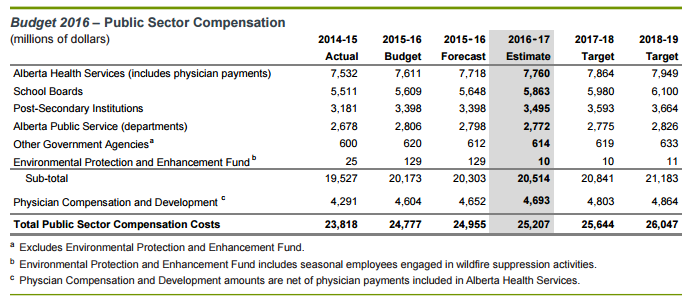
There it is - $25 Billion. Half of the budget is spent on public sector compensation. So if we just lay off roughly 90% of the sheriffs, teachers, doctors, nurses, lifeguards, administrative assistants, professors, meat inspectors, and firefighters, we'll be able to "bring back the Alberta Advantage!", lower taxes, live within our means, and save oil & gas revenue for the future. We'll just have to get used to 3 day wait times in the ER, elementary school class sizes of 100 students, and sheriffs driving schools buses full of violent offenders to fully automated jails.
If that sounds ridiculous, it's because it's supposed to.
But in case you weren't aware: the contracts between the government and the public sector unions are coming due. And nobody really expects the NDP to bring a salary freeze or mass layoffs to the table, which means that with new agreements the cost is likely going to get higher, not lower.
Look, at the end of the day, we all have programs that we like, and programs we see no purpose for. Some people see no reason for government to be in the business of fighting forest fires, until they see a glow coming over the hill. There are inarguably some government expenses that are far too high, and likely some that could stand to come off the books altogether.
But the larger discussion to be had here, is what we actually think government should be doing. What is its role, and what do we leave to the private sector? Should we, as Alberta taxpayers, be helping Alberta businesses, or let the market determine who succeeds and who fails? Should we promote tourism? Should we provide student loans, or let the students fight for the available scholarships and bursaries? Should we pay for parks, or charge users to get in? Until we've had that discussion, as a society, we can't get this funding issue under control.
A party or politician that proposes to hold the line on expenses needs to explain how they propose to pay for it all, without saddling future generations with so much debt they'll never be able to recover.
A party or politician that proposes to lower taxes is going to need to explain what specific programs they are going to cut, and how many Albertans they're going to send to the unemployment line, to save the $10B or more they need to balance the books while also reducing revenue.
There's plenty of blame to go around for the current situation - but blame isn't going to fix our problem. You can blame Redford, or Prentice, or Stelmach, or Klein - hell, blame Brownlee for all I care - but after you're done blaming somebody for this mess, we have to have a serious discussion about the government services we use, and whether we can have all the nice things that we want without paying higher taxes (spoiler: we can't).
We have, as politically engaged Albertans, fiddled for far too long while our fiscal Rome burned around us. Some of our politicians have tried to warn us that this reckoning was coming - but it's here, now.
What are we going to do about it?
The government budget documents are here. Go there, read through them, and find building projects, programs and jobs to cut. Or find taxes to raise. You, humble reader, are no less qualified than anyone else to suggest ways we can get our house in order.
So, let's do this. Let's fix the problem.
Show me the money.
Friday, September 16, 2016
Voter, Inform Thyself
Nation, one of the great truisms of politics is that "a little knowledge is a dangerous thing".
Voters who know something to be true - or even worse, FEEL it to be true - will latch on to that thing, disregard all other opinions or contrary facts, and will ride that certainty all the way to the polling station, stopping along the way only to encourage other people to follow them and their way of thinking and to mark their ballot the same way.
This hesitation towards engaging in fulsome discussion and seeking out contrary opinions is understandable. We're busy. We're working a lot - those of us lucky enough to have a job, anyhow. We've got Twitter wars to get into. We have cat videos to watch. Who's got time to discuss issues of policy divergence when ERMAGERDLOOKATDAKITTY...
Sorry. Where was I?
Right. Informed voters.
Most of us don't have the time or inclination to agonize over our choice at the ballot box, or how we feel about a given issue. So we cheat. We watch a video our cousin posted on Facebook about vaccines, and we decide that vaccines are bad. Or we read a 5 paragraph excerpt from a 400-page book with an impressive title about fluoride, and we decide that fluoride is okay. We let ourselves conclude that if every caller to the talk radio show this morning had something bad to say about the Prime Minister, we should probably hate him too. We read a guest column in the paper attacking a member of city council for spending tax dollars on public art, so we decide we have to rid ourselves of that councilor. And maybe of public art, too, while we're at it.
This abdication of our responsibility to our fellow citizens to inform ourselves is a direct threat to our democratic principles. Choosing our representatives based on poor information we cobbled together with the minimal amount of effort - or that well-connected, well-funded campaigns and citizens made sure we'd see - and then ignoring them for 4 years isn't a democracy, it's an oligarchy with an election-day opening act.
Which brings me to the issue of endorsements.
There was a noteworthy, though not-at-all unexpected, endorsement in the news today: PC MLA Mike Ellis, of Calgary-West, endorsed Jason Kenney for Leader of the PCAA.
I don't have any ill will towards Mike Ellis whatsoever. He's a good guy, a very effective MLA, and has been there for the party in the almost 18 months since the election loss, unlike many former MLAs and leadership candidates who completely ghosted once they lost power, resurfacing with a sudden interest in the party's leadership race only when it became apparent the party was unlikely to die on its own. I don't share Ellis' assertion that "Egos and arrogance" are the only reasons the PCAA and Wildrose Parties wouldn't merge, but we're allowed to have differences of opinion. There will likely be other endorsements from within the current PC Caucus coming as well. I'd bet my life on one of them.
However, as I have stated before: Endorsements are, by and large, meaningless. And they SHOULD be.
When we allow a celebrity endorsement of a product or politician to sway us towards buying that product or voting for that candidate, we're telling the world that David Hasselhoff or John Legend are so much better informed than we are that we'll just take their word for it, and do what they tell us to.
Likewise, when we allow an endorsement from a public official or a newspaper editorial to colour our opinion or effect our vote, we're in essence saying "I can't be trusted to make this decision, so someone else should make it for me. Here's my ballot, tell me what to do with it.". It's a dangerous move, with real and lasting implications.
Long-time readers of this blog will note that I don't use this platform to endorse candidates for office. Have I met many of the people I write about in this space? Absolutely. I've had the pleasure of interviewing dozens of candidates for office for this blog and others, and I'd like to think that over the course of my interviews with them I've gotten a good feel for their issues, policy ideas, principles, etc. But whether or not my opinions are informed, the important thing to remember is that they're just MY OPINIONS. What matters to me might not matter to you. And whether or not I like a candidate or a party shouldn't in any way be reflected in your vote. I'll present facts, or an argument, It's up to YOU to decide who to vote for.
There are 2 people who have thus far declared themselves candidates for the PC Leadership. There will likely be more as we get closer to the official launch of the leadership race in 2 weeks. I have met both of the currently declared candidates in the past, and personally like them both. They've articulated distinctly different visions for the future of the PC Party, and that's a good thing. Competing visions for the future is good, and the more of those we have, the better party members will be able to determine which candidate best represents their views.
BUT...
You've got to WORK for it. Don't just read my blog - or ANY blog - for information about these candidates. Don't take your MLA's word for it on who the best leader will be (that worked out SO well for us and for Alberta last time). Don't wait for the paper to endorse someone. Don't let talk radio do your thinking for you. Don't let retweets and Facebook "shares" from your friends or coworkers decide for you. Don't let someone else tell you what Lougheed would have wanted, or what Ralph would have done.
MEET these candidates. Do your homework. Ask them questions, in person or on social media. And if they don't answer your question, ask them again. Keep asking until you get an answer.
And make sure you elect local delegates to attend the leadership convention who have done the same.
The way the delegated convention works, they'll need to have a second choice, and a third choice, in case their first choice gets eliminated. Even if their first choice isn't one you share, you want thoughtful delegates who aren't going to be swayed by public endorsements from public figures.
After all... you wouldn't want an MLA who voted on your behalf to shut down the oilsands because Leo Di Caprio said it was a good idea, would you? Or a city councilor who voted to give the Flames hundreds of millions of tax dollars for a rink because Gary Bettman said it was a good idea?
You expect your representatives to make good decisions, based on facts and after studying all sides of an issue, regardless of the opinions of celebrities.
Set the example for them.
Get to work.
Voters who know something to be true - or even worse, FEEL it to be true - will latch on to that thing, disregard all other opinions or contrary facts, and will ride that certainty all the way to the polling station, stopping along the way only to encourage other people to follow them and their way of thinking and to mark their ballot the same way.
This hesitation towards engaging in fulsome discussion and seeking out contrary opinions is understandable. We're busy. We're working a lot - those of us lucky enough to have a job, anyhow. We've got Twitter wars to get into. We have cat videos to watch. Who's got time to discuss issues of policy divergence when ERMAGERDLOOKATDAKITTY...
Sorry. Where was I?
Right. Informed voters.
Most of us don't have the time or inclination to agonize over our choice at the ballot box, or how we feel about a given issue. So we cheat. We watch a video our cousin posted on Facebook about vaccines, and we decide that vaccines are bad. Or we read a 5 paragraph excerpt from a 400-page book with an impressive title about fluoride, and we decide that fluoride is okay. We let ourselves conclude that if every caller to the talk radio show this morning had something bad to say about the Prime Minister, we should probably hate him too. We read a guest column in the paper attacking a member of city council for spending tax dollars on public art, so we decide we have to rid ourselves of that councilor. And maybe of public art, too, while we're at it.
This abdication of our responsibility to our fellow citizens to inform ourselves is a direct threat to our democratic principles. Choosing our representatives based on poor information we cobbled together with the minimal amount of effort - or that well-connected, well-funded campaigns and citizens made sure we'd see - and then ignoring them for 4 years isn't a democracy, it's an oligarchy with an election-day opening act.
Which brings me to the issue of endorsements.
There was a noteworthy, though not-at-all unexpected, endorsement in the news today: PC MLA Mike Ellis, of Calgary-West, endorsed Jason Kenney for Leader of the PCAA.
I don't have any ill will towards Mike Ellis whatsoever. He's a good guy, a very effective MLA, and has been there for the party in the almost 18 months since the election loss, unlike many former MLAs and leadership candidates who completely ghosted once they lost power, resurfacing with a sudden interest in the party's leadership race only when it became apparent the party was unlikely to die on its own. I don't share Ellis' assertion that "Egos and arrogance" are the only reasons the PCAA and Wildrose Parties wouldn't merge, but we're allowed to have differences of opinion. There will likely be other endorsements from within the current PC Caucus coming as well. I'd bet my life on one of them.
However, as I have stated before: Endorsements are, by and large, meaningless. And they SHOULD be.
When we allow a celebrity endorsement of a product or politician to sway us towards buying that product or voting for that candidate, we're telling the world that David Hasselhoff or John Legend are so much better informed than we are that we'll just take their word for it, and do what they tell us to.
Likewise, when we allow an endorsement from a public official or a newspaper editorial to colour our opinion or effect our vote, we're in essence saying "I can't be trusted to make this decision, so someone else should make it for me. Here's my ballot, tell me what to do with it.". It's a dangerous move, with real and lasting implications.
Long-time readers of this blog will note that I don't use this platform to endorse candidates for office. Have I met many of the people I write about in this space? Absolutely. I've had the pleasure of interviewing dozens of candidates for office for this blog and others, and I'd like to think that over the course of my interviews with them I've gotten a good feel for their issues, policy ideas, principles, etc. But whether or not my opinions are informed, the important thing to remember is that they're just MY OPINIONS. What matters to me might not matter to you. And whether or not I like a candidate or a party shouldn't in any way be reflected in your vote. I'll present facts, or an argument, It's up to YOU to decide who to vote for.
There are 2 people who have thus far declared themselves candidates for the PC Leadership. There will likely be more as we get closer to the official launch of the leadership race in 2 weeks. I have met both of the currently declared candidates in the past, and personally like them both. They've articulated distinctly different visions for the future of the PC Party, and that's a good thing. Competing visions for the future is good, and the more of those we have, the better party members will be able to determine which candidate best represents their views.
BUT...
You've got to WORK for it. Don't just read my blog - or ANY blog - for information about these candidates. Don't take your MLA's word for it on who the best leader will be (that worked out SO well for us and for Alberta last time). Don't wait for the paper to endorse someone. Don't let talk radio do your thinking for you. Don't let retweets and Facebook "shares" from your friends or coworkers decide for you. Don't let someone else tell you what Lougheed would have wanted, or what Ralph would have done.
MEET these candidates. Do your homework. Ask them questions, in person or on social media. And if they don't answer your question, ask them again. Keep asking until you get an answer.
And make sure you elect local delegates to attend the leadership convention who have done the same.
The way the delegated convention works, they'll need to have a second choice, and a third choice, in case their first choice gets eliminated. Even if their first choice isn't one you share, you want thoughtful delegates who aren't going to be swayed by public endorsements from public figures.
After all... you wouldn't want an MLA who voted on your behalf to shut down the oilsands because Leo Di Caprio said it was a good idea, would you? Or a city councilor who voted to give the Flames hundreds of millions of tax dollars for a rink because Gary Bettman said it was a good idea?
You expect your representatives to make good decisions, based on facts and after studying all sides of an issue, regardless of the opinions of celebrities.
Set the example for them.
Get to work.
Thursday, July 7, 2016
School Daze
Nation, the dog-whistle of "politicians determining what's taught in schools!" has reared its ugly head again.
Much like "politicians deciding their own salaries", "politicians determining what's taught in schools" is one of those tried-and-true hot button issues that never ceases to piss off voters who are angry that people who don't agree with them about every single issue actually got elected. And of course, the politicians are in a classic no-win scenario - as soon as they put the issue out of their direct control and say "we've got an equation now that will automatically set the pay for our council members" or "we've appointed experts in the field to determine curriculum for students in this province", the people who are against whatever the outcome is go completely ballistic in their demands for the politicians to directly insert themselves back INTO the process, with old saws like "council should vote down the pay increase that the equation gave them", or "we need to elect a government that will get back to the 3 R's".
Well, with the assertion by some of the usual suspects that a cadre of socialist activist teachers and the Notley Government are using curriculum redesign - and, by extension, the entire school system - to program collectivist, anti-Christian, anti-conservative ideals into our unsuspecting children, I have a humble suggestion:
Pull your kids out of school.
If you really believe that the teachers at your kids' school are trying to brainwash them with values and ideas that you don't want them to have... pull them out. Homeschool them. It's completely within your rights. Don't let the pinko commies have access to your kids, and your kids won't have to learn about "the gays". If you know better than the teacher what your kids need and how they learn, then YOU be the teacher.
What's that? You don't have time to stay home with the kids? Well, I guess that's a valid point - though, I was always told that if something's important, you MAKE the time... but whatever. You've made your choice, and your choice is to drop your little darlings off at a publicly-funded institution of learning for 7-or-so hours per day.
That's perfectly fine. Nobody's judging you. Most of your neighbours send their kids to these wretched hives of scum and villainy, too.
But if you're going to avail yourself of this building full of trained professionals who are going to take responsibility for educating your children, you have to accept that you no longer have exclusive control and pre-approval of every single fact that they're exposed to. In choosing to use the public education system, you forfeited that right. They're going to hear things from the teacher that they've never heard from you. They're going to hear things from their fellow students that they've never heard from you.
Do you still have a say? SURE you do. You get to elect a school board. You get to elect an MLA. You get to attend parent council meetings, and meetings with the teacher, and you can call the principal and storm into her office any time you like to rail against your kids learning about Islam or the metric system or being told that the world is over a billion years old. You have a say.
But what you DON'T have is control.
And if you WANT control, you have only one choice:
Pull your kids out of school.
Pull them out, and those lazy socialist teachers and their propagandist curriculum cooked up around Notley's kitchen table while they were reading the Communist Manifesto won't be your problem.
But if you're going to use the public system, you have to accept that your opinion doesn't make something true, or factual. Your kids are going to be exposed to information you don't agree with. You don't have control.
Yes, I know you pay taxes. I know that your money goes into running those schools, and paying those teachers, and as a taxpayer you have a right to value for your money.
But I'll tell you what: Start the car right now, go downtown, and drive the wrong way up a one-way street. Swerve around a lot. Wave a bottle of whisky out the window. When the nice police officer stops you for a chat, tell him that you pay taxes, your money goes into paving that road and paying his salary, and as a taxpayer you demand that he just let you go on your merry way.
Or even better: Drive up to Edmonton. Visit our beautiful Legislature. Walk through security, and head straight for the Premier's Office. Pound on the door, and demand to sit in her chair. Because you're a taxpayer, and you paid for the chair, and you pay the salaries of everyone in the building.
Let me know how that works out for you.
Here's the thing: You can't opt out of traffic laws. If you're going to drive, you have to obey them. And you can't opt out of being governed by someone you disagree with. Unless you move to another jurisdiction, the laws they pass will still apply to you.
But you CAN opt out of those terrible public schools, and those collectivist teachers, fangs dripping with the venom of Che Guevara worship and union politics, and the shockingly secular and humanist curriculum. You can't opt out of PAYING for it, just like you can't opt out of paying for cops and roads and the offices of politicians you don't like, but you can choose to not expose your kids to the horrors of public education.
Pull your kids out of school, teach them only what you believe to be true, and make sure they're not exposed to other ideas, lest they be confused by the notion of pluralism.
It'll make it easier for the rest of us to get our kids INTO what is one of the best public school systems in the history of civilization.
Everybody wins.
Well, almost everybody.
But you know what's best for your kids. So do it.
Much like "politicians deciding their own salaries", "politicians determining what's taught in schools" is one of those tried-and-true hot button issues that never ceases to piss off voters who are angry that people who don't agree with them about every single issue actually got elected. And of course, the politicians are in a classic no-win scenario - as soon as they put the issue out of their direct control and say "we've got an equation now that will automatically set the pay for our council members" or "we've appointed experts in the field to determine curriculum for students in this province", the people who are against whatever the outcome is go completely ballistic in their demands for the politicians to directly insert themselves back INTO the process, with old saws like "council should vote down the pay increase that the equation gave them", or "we need to elect a government that will get back to the 3 R's".
Well, with the assertion by some of the usual suspects that a cadre of socialist activist teachers and the Notley Government are using curriculum redesign - and, by extension, the entire school system - to program collectivist, anti-Christian, anti-conservative ideals into our unsuspecting children, I have a humble suggestion:
Pull your kids out of school.
If you really believe that the teachers at your kids' school are trying to brainwash them with values and ideas that you don't want them to have... pull them out. Homeschool them. It's completely within your rights. Don't let the pinko commies have access to your kids, and your kids won't have to learn about "the gays". If you know better than the teacher what your kids need and how they learn, then YOU be the teacher.
What's that? You don't have time to stay home with the kids? Well, I guess that's a valid point - though, I was always told that if something's important, you MAKE the time... but whatever. You've made your choice, and your choice is to drop your little darlings off at a publicly-funded institution of learning for 7-or-so hours per day.
That's perfectly fine. Nobody's judging you. Most of your neighbours send their kids to these wretched hives of scum and villainy, too.
But if you're going to avail yourself of this building full of trained professionals who are going to take responsibility for educating your children, you have to accept that you no longer have exclusive control and pre-approval of every single fact that they're exposed to. In choosing to use the public education system, you forfeited that right. They're going to hear things from the teacher that they've never heard from you. They're going to hear things from their fellow students that they've never heard from you.
Do you still have a say? SURE you do. You get to elect a school board. You get to elect an MLA. You get to attend parent council meetings, and meetings with the teacher, and you can call the principal and storm into her office any time you like to rail against your kids learning about Islam or the metric system or being told that the world is over a billion years old. You have a say.
But what you DON'T have is control.
And if you WANT control, you have only one choice:
Pull your kids out of school.
Pull them out, and those lazy socialist teachers and their propagandist curriculum cooked up around Notley's kitchen table while they were reading the Communist Manifesto won't be your problem.
But if you're going to use the public system, you have to accept that your opinion doesn't make something true, or factual. Your kids are going to be exposed to information you don't agree with. You don't have control.
Yes, I know you pay taxes. I know that your money goes into running those schools, and paying those teachers, and as a taxpayer you have a right to value for your money.
But I'll tell you what: Start the car right now, go downtown, and drive the wrong way up a one-way street. Swerve around a lot. Wave a bottle of whisky out the window. When the nice police officer stops you for a chat, tell him that you pay taxes, your money goes into paving that road and paying his salary, and as a taxpayer you demand that he just let you go on your merry way.
Or even better: Drive up to Edmonton. Visit our beautiful Legislature. Walk through security, and head straight for the Premier's Office. Pound on the door, and demand to sit in her chair. Because you're a taxpayer, and you paid for the chair, and you pay the salaries of everyone in the building.
Let me know how that works out for you.
Here's the thing: You can't opt out of traffic laws. If you're going to drive, you have to obey them. And you can't opt out of being governed by someone you disagree with. Unless you move to another jurisdiction, the laws they pass will still apply to you.
But you CAN opt out of those terrible public schools, and those collectivist teachers, fangs dripping with the venom of Che Guevara worship and union politics, and the shockingly secular and humanist curriculum. You can't opt out of PAYING for it, just like you can't opt out of paying for cops and roads and the offices of politicians you don't like, but you can choose to not expose your kids to the horrors of public education.
Pull your kids out of school, teach them only what you believe to be true, and make sure they're not exposed to other ideas, lest they be confused by the notion of pluralism.
It'll make it easier for the rest of us to get our kids INTO what is one of the best public school systems in the history of civilization.
Everybody wins.
Well, almost everybody.
But you know what's best for your kids. So do it.
Thursday, June 23, 2016
Oh My God - They Killed Kenney!
Nation, as has been widely reported in the press over the past few days, Jason Kenney - prolific cabinet minister in the governments of Stephen Harper and Member of Parliament for Calgary Midnapore - is testing the waters for a run for the vacant leadership of the Progressive Conservative Association of Alberta.
The thought here is that if Kenney can come home to Alberta and win the leadership of the PC's - which will be decided by next summer - then the schism on the centre-right of Alberta politics would be healed by an exodus of Wildrose members who would either join the Kenney PC's, or would be willing to leave Wildrose for an entirely new party. Leaving a united right to cruise to power in an expected 2019 provincial election.
Pundits and party rank-and-file from both sides of Alberta's conservative "family feud" have weighed in, talking about how it could be done, why it does or doesn't make sense, and whether Kenney should actually make the jump to provincial politics or run for the leadership of the federal Conservatives.
So, let's ask the important questions:
1. CAN Jason Kenney win the leadership of the PCAA?
Yes, he can.
The new leadership selection process for the PCAA is a delegated convention - which is exactly the type of convention they're been using for years to vote on issues like the party's executive board, policies, and constitutional amendments. So it's not like this is an entirely new process that nobody has any insight into the inner workings of. If Kenney can gain the support of a majority of the voting delegates in the leadership race - roughly 700 people - he can win the leadership.
2. HOW can he win?
No one's quite sure at this point whether the voting delegates are going to be selected by a vote of the local PC members in each constituency, or whether they'll be appointed by the local CA Boards. If it's the former, Kenney has the organizational chops to make sure he's got enough members signed up in enough ridings to tip the scales in his favour when the local vote is held. If it's the latter, Kenney would need to move quickly to have his supporters gain control of enough CA Boards to get friendly delegates appointed. The local Annual General Meeting is the most likely place for such a move, but how many CAs are having AGM's between now and when the delegates would be chosen?
3. What could go wrong?
The PC Party has the right to refuse or revoke the membership of anyone whose membership is deemed "not in the best interests of the Progressive Conservative Association of Alberta". This is not a common occurrence by any means, but it's a tool they have at their disposal.
So, just like the NDP did with the "Kudatah" gang who tried to sign up as members in order to take over the governing party from within, the PCAA has the ability to deny membership to anyone who they know isn't joining to help the PC cause.
And while this might be an overwhelmingly difficult task - there's no blood test for motives, after all - it's also conspicuously easy, in that there's only one membership you'd need to revoke or refuse in order to torpedo Kenney's chances of winning the PC leadership:
Jason Kenney.
If you're not a member-in-good-standing of the Party, you can't run for its leadership. All stop. And if Kenney is being up-front and public (he's not, yet - this is conjecture that's been bandied about in the press) about his desire to win the leadership of PCAA in order to start another party and get Wildrose supporters and PC supporters to meet on new terms, without either having to surrender to the other (the approach many argue would be the ONLY palatable or legal option available for a "merger"), then it's not a hard argument to make that Jason Kenney would therefore NOT be acting in the best interests of the PCAA - because he'd be advocating for its destruction.
I know, a lot of you think that doesn't sound like a bad idea, and that it would be in the best interest of Alberta, but the PCAA Board isn't bound by what you or I or the local mechanic think is best for Alberta. They're bound by what's best for the PCAA. When the 2 line up, decisions are easy. When they don't, decisions are a lot harder. This would be one of those times. If Kenney was declared ineligible to run for the leadership on account of his not being a member-in-good-standing, the effort would die right then and there.
4. What are the reasons for caution?
There are many. The first, and most obvious one, is money. Kenney is a fundraising machine - as was Jim Prentice before him - but the rules are different in Alberta now, and fundraising requires a broader stroke than it used to. But that's not what I'm talking about.
If the PCAA and Wildrose ceased to exist, the money in their central and local CA accounts would go buh-bye. Opinions on the accuracy of that statement vary, but the only interpretation that really matters is the interpretation of the organization that governs the finances of Alberta's political parties. And they say, in effect: If you cease to exist as a party, your money goes away. It cannot be transferred to a different party. It pays off party debt, then it sits for a year in case you change your mind, and then it goes into General Revenue. Both the PCAA and Wildrose are in the black when assets are weighed against liabilities, so that's a lot of money that goes off the table. Kenney could find more for the new party, to be sure, but fiscal conservatives hate to see money wasted - particularly money that was fundraised for conservative candidates, and ends up in the General Revenue fund to be spent by Rachel Notley.
The second is further vote-splitting. If Kenney is successful in winning the PCAA leadership, some of the party's moderate voices are going to leave, and either disengage or find new homes in the Alberta Party or the Liberals. How that number would compare to the number of Wildrose supporters who would join the Kenney PC's no one can say for certain. But there will be some in the Wildrose who steadfastly refuse to ever work with anyone who was involved in the PCAA, regardless of who their current leader is. And if those folks stay in the Wildrose, join the Alberta Reform Party, or start up another party entirely, it creates yet another vote-split on the right.
The third is tricky: Victory is not assured - either short-term OR long-term. When Jim Prentice rode in on his white horse to save the PCAA and Alberta as a whole, he did it with almost unanimous endorsement from the massive PC Caucus. As it turned out, the judgement of elected MLAs on issues of politics isn't completely unassailable after all, because a year later most of them were unemployed and Prentice was persona non grata.
Likewise is the possible case with Jason Kenney. Even if he got the support of most of the current PC Caucus (there's at least one member whose endorsement he shouldn't be counting on), and many of the former MLA's, those opinions carry a LOT less weight with rank-and-file PC members than they used to. Having been very recently burned by the judgement of their local "kingmakers", grassroots PC members have taken a more active and independent stance on issues like constitutional amendments and the election of a new provincial board. The question of the Party Leadership would likely fall into that category as well. If Kenney wants to win the leadership, he may have to do it DESPITE these present members, and that means signing up new members all across Alberta. He can likely count on the support of some of his federal Conservative allies, but can he count on all of them? Would the ones in Northern Alberta help him out, if it meant creating a headache for their pal and former caucus-mate Brian Jean? A smart strategy would be to target the constituencies with the smallest membership numbers, because you'd have less work to do - and under the delegated system, all constituencies top out at the same number of votes in a leadership contest, whether they have 20 party members in the riding, or 2000.
But even if Kenney DOES win the leadership, can he win the province? It would be a HUGE step backwards for him to leave federal politics, win the leadership of the Alberta PC's, and then achieve (at best) Leader of the Official Opposition status. He can have that in Ottawa, in a heartbeat.
In order for Kenney to win the Premier's Office and avoid the ignominious fate described above, he'd have to convince 2 of Alberta's 3 voting blocs that he and his party (whatever that party would be called or look like in 3 years) were the best choice to lead Alberta. The traditional 3 blocs in Alberta are Edmonton, Calgary, and Rural Alberta - if you can dominate 2 of those 3, you can win a majority government. Under Klein, the Tories dominated Calgary and Rural Alberta. Under Stelmach and Redford, they had great success in Calgary and Edmonton, but lost a lot of the rural south in the later years. Under Prentice, they lost all of Edmonton and much of Calgary - making overall defeat inevitable.
Can Jason Kenney win Edmonton? It would be a hard sell. His provincial policy positions aren't well known, but it's safe to say that fiscal restraint would be a big emphasis for the former head of the Canadian Taxpayer's Federation. Edmonton is an AUPE town, and preaching "fiscal restraint" in a union town sounds a lot like "salary freezes and layoffs". Which doesn't make the policy WRONG, mind you - it just makes it unlikely to help win you the popularity contest we call "an election".
Can Jason Kenney win Calgary? Absolutely he can. He's well-known in the city, his contacts run deep, and his pro-business message would be very popular. The only potential stumbling block for him in Calgary would be pipelines: If a pipeline getting Alberta oil to tidewater gets approved with the Trudeau Liberals in power in Ottawa and the Notley NDP in power in Edmonton, it makes the job of convincing Albertans that "only a conservative government can get our product to market" a lot harder.
Can Jason Kenney win Rural Alberta? Who the hell knows? He's not necessarily the best-known politician in rural Alberta, particularly as you get further away from Calgary, but the support of fellow Conservative MP's would go a long way to bridging that gap. But would Rural Alberta - particularly in the south - give another chance to a party that had a large plurality of former Progressive Conservatives in it? Would they elect a local candidate who had been a PC? Would they vote for a shiny, new 3rd party if half of their province-wide candidates had run as PC's in previous elections?
Kenney might do well to thank former PC candidates and MLAs (and Wildrose ones too, for that matter) for their support, and then make it clear he wouldn't sign nomination papers for any of them in the interest of giving Albertans something "clearly new" to vote for. You lose a lot of institutional and political wisdom from your potential caucus in that move, but you also permanently jettison a LOT of baggage.
Adding to the uncertainty, is the fact that with redistribution on the horizon, most pundits expect the overall weight of the rural constituencies to diminish in favour of more weight for the major cities.
So, after almost 2,000 words:
What do YOU think, Nation? Will he? SHOULD he? And if he does, will it work out the way he HOPES it will? Sound off below!
- Savage out.
The thought here is that if Kenney can come home to Alberta and win the leadership of the PC's - which will be decided by next summer - then the schism on the centre-right of Alberta politics would be healed by an exodus of Wildrose members who would either join the Kenney PC's, or would be willing to leave Wildrose for an entirely new party. Leaving a united right to cruise to power in an expected 2019 provincial election.
Pundits and party rank-and-file from both sides of Alberta's conservative "family feud" have weighed in, talking about how it could be done, why it does or doesn't make sense, and whether Kenney should actually make the jump to provincial politics or run for the leadership of the federal Conservatives.
So, let's ask the important questions:
1. CAN Jason Kenney win the leadership of the PCAA?
Yes, he can.
The new leadership selection process for the PCAA is a delegated convention - which is exactly the type of convention they're been using for years to vote on issues like the party's executive board, policies, and constitutional amendments. So it's not like this is an entirely new process that nobody has any insight into the inner workings of. If Kenney can gain the support of a majority of the voting delegates in the leadership race - roughly 700 people - he can win the leadership.
2. HOW can he win?
No one's quite sure at this point whether the voting delegates are going to be selected by a vote of the local PC members in each constituency, or whether they'll be appointed by the local CA Boards. If it's the former, Kenney has the organizational chops to make sure he's got enough members signed up in enough ridings to tip the scales in his favour when the local vote is held. If it's the latter, Kenney would need to move quickly to have his supporters gain control of enough CA Boards to get friendly delegates appointed. The local Annual General Meeting is the most likely place for such a move, but how many CAs are having AGM's between now and when the delegates would be chosen?
3. What could go wrong?
The PC Party has the right to refuse or revoke the membership of anyone whose membership is deemed "not in the best interests of the Progressive Conservative Association of Alberta". This is not a common occurrence by any means, but it's a tool they have at their disposal.
So, just like the NDP did with the "Kudatah" gang who tried to sign up as members in order to take over the governing party from within, the PCAA has the ability to deny membership to anyone who they know isn't joining to help the PC cause.
And while this might be an overwhelmingly difficult task - there's no blood test for motives, after all - it's also conspicuously easy, in that there's only one membership you'd need to revoke or refuse in order to torpedo Kenney's chances of winning the PC leadership:
Jason Kenney.
If you're not a member-in-good-standing of the Party, you can't run for its leadership. All stop. And if Kenney is being up-front and public (he's not, yet - this is conjecture that's been bandied about in the press) about his desire to win the leadership of PCAA in order to start another party and get Wildrose supporters and PC supporters to meet on new terms, without either having to surrender to the other (the approach many argue would be the ONLY palatable or legal option available for a "merger"), then it's not a hard argument to make that Jason Kenney would therefore NOT be acting in the best interests of the PCAA - because he'd be advocating for its destruction.
I know, a lot of you think that doesn't sound like a bad idea, and that it would be in the best interest of Alberta, but the PCAA Board isn't bound by what you or I or the local mechanic think is best for Alberta. They're bound by what's best for the PCAA. When the 2 line up, decisions are easy. When they don't, decisions are a lot harder. This would be one of those times. If Kenney was declared ineligible to run for the leadership on account of his not being a member-in-good-standing, the effort would die right then and there.
4. What are the reasons for caution?
There are many. The first, and most obvious one, is money. Kenney is a fundraising machine - as was Jim Prentice before him - but the rules are different in Alberta now, and fundraising requires a broader stroke than it used to. But that's not what I'm talking about.
If the PCAA and Wildrose ceased to exist, the money in their central and local CA accounts would go buh-bye. Opinions on the accuracy of that statement vary, but the only interpretation that really matters is the interpretation of the organization that governs the finances of Alberta's political parties. And they say, in effect: If you cease to exist as a party, your money goes away. It cannot be transferred to a different party. It pays off party debt, then it sits for a year in case you change your mind, and then it goes into General Revenue. Both the PCAA and Wildrose are in the black when assets are weighed against liabilities, so that's a lot of money that goes off the table. Kenney could find more for the new party, to be sure, but fiscal conservatives hate to see money wasted - particularly money that was fundraised for conservative candidates, and ends up in the General Revenue fund to be spent by Rachel Notley.
The second is further vote-splitting. If Kenney is successful in winning the PCAA leadership, some of the party's moderate voices are going to leave, and either disengage or find new homes in the Alberta Party or the Liberals. How that number would compare to the number of Wildrose supporters who would join the Kenney PC's no one can say for certain. But there will be some in the Wildrose who steadfastly refuse to ever work with anyone who was involved in the PCAA, regardless of who their current leader is. And if those folks stay in the Wildrose, join the Alberta Reform Party, or start up another party entirely, it creates yet another vote-split on the right.
The third is tricky: Victory is not assured - either short-term OR long-term. When Jim Prentice rode in on his white horse to save the PCAA and Alberta as a whole, he did it with almost unanimous endorsement from the massive PC Caucus. As it turned out, the judgement of elected MLAs on issues of politics isn't completely unassailable after all, because a year later most of them were unemployed and Prentice was persona non grata.
Likewise is the possible case with Jason Kenney. Even if he got the support of most of the current PC Caucus (there's at least one member whose endorsement he shouldn't be counting on), and many of the former MLA's, those opinions carry a LOT less weight with rank-and-file PC members than they used to. Having been very recently burned by the judgement of their local "kingmakers", grassroots PC members have taken a more active and independent stance on issues like constitutional amendments and the election of a new provincial board. The question of the Party Leadership would likely fall into that category as well. If Kenney wants to win the leadership, he may have to do it DESPITE these present members, and that means signing up new members all across Alberta. He can likely count on the support of some of his federal Conservative allies, but can he count on all of them? Would the ones in Northern Alberta help him out, if it meant creating a headache for their pal and former caucus-mate Brian Jean? A smart strategy would be to target the constituencies with the smallest membership numbers, because you'd have less work to do - and under the delegated system, all constituencies top out at the same number of votes in a leadership contest, whether they have 20 party members in the riding, or 2000.
But even if Kenney DOES win the leadership, can he win the province? It would be a HUGE step backwards for him to leave federal politics, win the leadership of the Alberta PC's, and then achieve (at best) Leader of the Official Opposition status. He can have that in Ottawa, in a heartbeat.
In order for Kenney to win the Premier's Office and avoid the ignominious fate described above, he'd have to convince 2 of Alberta's 3 voting blocs that he and his party (whatever that party would be called or look like in 3 years) were the best choice to lead Alberta. The traditional 3 blocs in Alberta are Edmonton, Calgary, and Rural Alberta - if you can dominate 2 of those 3, you can win a majority government. Under Klein, the Tories dominated Calgary and Rural Alberta. Under Stelmach and Redford, they had great success in Calgary and Edmonton, but lost a lot of the rural south in the later years. Under Prentice, they lost all of Edmonton and much of Calgary - making overall defeat inevitable.
Can Jason Kenney win Edmonton? It would be a hard sell. His provincial policy positions aren't well known, but it's safe to say that fiscal restraint would be a big emphasis for the former head of the Canadian Taxpayer's Federation. Edmonton is an AUPE town, and preaching "fiscal restraint" in a union town sounds a lot like "salary freezes and layoffs". Which doesn't make the policy WRONG, mind you - it just makes it unlikely to help win you the popularity contest we call "an election".
Can Jason Kenney win Calgary? Absolutely he can. He's well-known in the city, his contacts run deep, and his pro-business message would be very popular. The only potential stumbling block for him in Calgary would be pipelines: If a pipeline getting Alberta oil to tidewater gets approved with the Trudeau Liberals in power in Ottawa and the Notley NDP in power in Edmonton, it makes the job of convincing Albertans that "only a conservative government can get our product to market" a lot harder.
Can Jason Kenney win Rural Alberta? Who the hell knows? He's not necessarily the best-known politician in rural Alberta, particularly as you get further away from Calgary, but the support of fellow Conservative MP's would go a long way to bridging that gap. But would Rural Alberta - particularly in the south - give another chance to a party that had a large plurality of former Progressive Conservatives in it? Would they elect a local candidate who had been a PC? Would they vote for a shiny, new 3rd party if half of their province-wide candidates had run as PC's in previous elections?
Kenney might do well to thank former PC candidates and MLAs (and Wildrose ones too, for that matter) for their support, and then make it clear he wouldn't sign nomination papers for any of them in the interest of giving Albertans something "clearly new" to vote for. You lose a lot of institutional and political wisdom from your potential caucus in that move, but you also permanently jettison a LOT of baggage.
Adding to the uncertainty, is the fact that with redistribution on the horizon, most pundits expect the overall weight of the rural constituencies to diminish in favour of more weight for the major cities.
So, after almost 2,000 words:
- Can Kenney win the PC Leadership? Yes.
- Can he be stopped? Yes.
- Is running for the leadership in the best interests of Alberta? That's up to you to decide your opinion on.
- Is it in the best interest of Jason Kenney? A soft MAYBE. He might be the next Brad Wall (presumably without the deficits). He might be the next Jim Prentice.
What do YOU think, Nation? Will he? SHOULD he? And if he does, will it work out the way he HOPES it will? Sound off below!
- Savage out.
Saturday, December 12, 2015
Blind Leading The Blind
I've written this blog post 3 times now.
The first time, I completed it, only to read back and realize I was casting aspersions on the motives of certain people. That wasn't my intention, but it happened early on, and soured the whole post. So I trashed it and started over.
The second time, I made some pretty big assumptions about the most likely power-brokers behind the scenes. I realized that wasn't what I actually wanted to write about, so I cleared the screen, and started over.
Here's the thing: I don't find writing as enjoyable as I used to. It takes a lot of time - a LOT of it - to get things written down just the way I want them. In that time, people have already used Twitter and Facebook to make up their minds on a given issue, and once they cross the line from "idea I favour" to "belief I hold", there's no point in trying to convince them otherwise. Beliefs are tricky.
Add to this that for the most part, I've been filling my time either with a) my family, which is absolutely where my focus belongs, or b) work, which in this economy is a blessing that can't be ignored, and it's a little more clear why I've only been able to rattle off a half-dozen blog posts in the space of a calendar year that included both a provincial election AND a federal election.
But, when something gets me REALLY fired up, I can't help myself.
There has been a lot of talk lately about "uniting the right" in Alberta. Wildrose Leader Brian Jean talked about it at his party's AGM, in the context that Progressive Conservative supporters should buy Wildrose memberships, and join the ascendant party. He changed his tone at a recent fundraiser, and left several other options on the table, whether it was a re-brand of Wildrose (along the lines of the Reform Party's evolution to the Canadian Alliance) or to possibly fold up both the Progressive Conservative Association of Alberta AND the Wildrose Party, and create an entirely new entity out of the ashes of both.
We've also been hearing from former PC MLA's that this is exactly what they want to see. They argue that this is the right thing for Alberta, that we need to end vote-splitting on the right to keep Notley from winning a second term in 2019 or 2020.
I have come to respect some of these vocal former MLA's. Some of them are my friends.
And they don't know what the hell they're talking about.
If I can pull back the veil for a minute, as someone who has worked closely with MLA's, I want to share something with all of you that might not be readily evident:
MLA's are just people. That's it. They're not demi-gods. You don't find them sitting on top of a mountain dispensing wisdom (well, except for one - Hi Dave!). They're no more special than you or me. They're not necessarily smarter. Or more gifted. And I say that with all the love in the world. They're just like the rest of us - and they're SUPPOSED to be. That's the entire point.
"But, but, but... E.S., these people got ELECTED! Something that, BY THE WAY, you couldn't manage to do when you tried it. They live and breathe politics! Surely, they know what the right thing to do is?"
Let's step back.
What does it take to become an MLA, and get a beautiful Mace lapel pin?
First of all, you have to win a nomination race. Depending on the timing and the party, that may be as simple as being the only person to have stepped forward, or you may have to run in a contested vote. Or, in some cases (Hi, Jono!) MORE than one contested vote (ah, 2008...). But even if the race is contested, in some instances and parties a hundred to a few hundred votes will get you the win. Getting a hundred votes is hard. You need to be organized, and work hard, but it's not 10,000 votes.
AFTER you win your nomination race, and receive the blessing of your chosen party... you don't necessarily have to do ANYTHING. I mean, it can certainly help your chances if you go out to the community, knock on doors, attend the local barn dance, show up at PTA meetings and 4H meetings and the like, but ultimately (as much as I wish it were otherwise), your fate as a candidate has more to do with the performance of your party's Leader and central campaign staff than anything you're going to do.
Don't get me wrong - a great candidate and a great local team can - and do - work miracles from time to time. But for every great candidate who beats long odds, there are 20 candidates - be they phenomenally gifted politicians or just regular folks who had the courage to step forward - who work incredibly hard, but lose because they're running under the wrong leader, at the wrong time, in the wrong riding.
And we have only to look at the results from this past May to see exactly what I mean. We saw a lot of people elected as MLA's who barely campaigned, raised and spent virtually no money, but they were the local candidate for the party whose Leader had captured the imagination of the electorate. That's not a condemnation of them - not by a long shot. But let's call a spade a spade: The candidates who won - and the candidates they defeated - were not, in most cases, the masters of their own destiny.
And it's always been this way. It's the unavoidable result of the Party system, where voters focus on the Party Leaders and barely pay any attention to the local candidates. As a result, we have to accept that the candidates who are elected won't necessarily be the best local choice - rather, they were (in many cases) the candidate representing the correct Party for a plurality of their local voters. But whatever they ARE, we have to accept that they're NOT better than we are. They put their shoes on one foot at a time.
And they make mistakes.
Here's a fun fact: Of the 43 sitting PC MLA's who ran for re-election and lost in 2015, 39 of them endorsed Jim Prentice for PC Leader. Some of them went further, and actually helped the "draft Jim" movement that changed Prentice's initial "no" to a "yes". If you accept - as many do - that Prentice and his pals and their campaign strategy were what sank the Battleship Tory, then you have to accept that those 39 former MLA's - some of them among the most vocal of the "unite the right" crowd - exercised TERRIBLE judgement in throwing their unequivocal support - not to mention their livelihoods - to a guy who would leave them unemployed and defeated 243 days after winning the party leadership, and barely 4 months after absorbing most of their Official Opposition in the Legislature (a move those defeated MLA's also publicly and enthusiastically endorsed at the time).
They bet on Prentice as the guy to appeal to Martha and Henry. They bet on him to bring some of that "Harper Magic" back to Alberta where it was born. They bet on him to get pipelines built, save Alberta's economy, and also (incidentally) their jobs. They backed his early election call. They backed his backroom deal with the Wildrose defectors. They gave him everything he wanted, in the hopes that people would forget most of them were elected as enthusiastic candidates for the Alison Redford PC's in 2012.
In short: These defeated former MLA's screwed up. BIG time.
If these former PC MLA's want to join the Wildrose so badly, they can buy a membership. Here's the link. They may want to consider, though, that under the current PCAA Code of Conduct, they can't be PC candidates in the future if they hold a membership in another provincial party. Or maybe they've already considered that, which is why a merger is so damned important to them.
Power's addictive. Being an MLA - especially a government MLA - is a position of power and influence. It's a chance to make your community, and society, better. Whatever that means to you. I can completely understand why someone would want the job. And I completely understand why someone who LOST the job - maybe through little fault of their own - would want to do whatever they could to remove barriers to them getting it back in the future.
I totally understand.
But just because you WANT it, doesn't make it "what's best for Albertans".
And even if you really believe, in your heart of hearts, that a merger IS what's best for Albertans, let me tell you: you're wrong.
Just like you were wrong about Jim.
The first time, I completed it, only to read back and realize I was casting aspersions on the motives of certain people. That wasn't my intention, but it happened early on, and soured the whole post. So I trashed it and started over.
The second time, I made some pretty big assumptions about the most likely power-brokers behind the scenes. I realized that wasn't what I actually wanted to write about, so I cleared the screen, and started over.
Here's the thing: I don't find writing as enjoyable as I used to. It takes a lot of time - a LOT of it - to get things written down just the way I want them. In that time, people have already used Twitter and Facebook to make up their minds on a given issue, and once they cross the line from "idea I favour" to "belief I hold", there's no point in trying to convince them otherwise. Beliefs are tricky.
Add to this that for the most part, I've been filling my time either with a) my family, which is absolutely where my focus belongs, or b) work, which in this economy is a blessing that can't be ignored, and it's a little more clear why I've only been able to rattle off a half-dozen blog posts in the space of a calendar year that included both a provincial election AND a federal election.
But, when something gets me REALLY fired up, I can't help myself.
There has been a lot of talk lately about "uniting the right" in Alberta. Wildrose Leader Brian Jean talked about it at his party's AGM, in the context that Progressive Conservative supporters should buy Wildrose memberships, and join the ascendant party. He changed his tone at a recent fundraiser, and left several other options on the table, whether it was a re-brand of Wildrose (along the lines of the Reform Party's evolution to the Canadian Alliance) or to possibly fold up both the Progressive Conservative Association of Alberta AND the Wildrose Party, and create an entirely new entity out of the ashes of both.
Note: I'm not in favour. But that's a blog post for another day, and it's not the subject of this one. When that post comes, I'll be honoured to argue with all of you about the pros and cons until we need to consume all the scotch in Christendom.
We've also been hearing from former PC MLA's that this is exactly what they want to see. They argue that this is the right thing for Alberta, that we need to end vote-splitting on the right to keep Notley from winning a second term in 2019 or 2020.
I have come to respect some of these vocal former MLA's. Some of them are my friends.
And they don't know what the hell they're talking about.
If I can pull back the veil for a minute, as someone who has worked closely with MLA's, I want to share something with all of you that might not be readily evident:
MLA's are just people. That's it. They're not demi-gods. You don't find them sitting on top of a mountain dispensing wisdom (well, except for one - Hi Dave!). They're no more special than you or me. They're not necessarily smarter. Or more gifted. And I say that with all the love in the world. They're just like the rest of us - and they're SUPPOSED to be. That's the entire point.
"But, but, but... E.S., these people got ELECTED! Something that, BY THE WAY, you couldn't manage to do when you tried it. They live and breathe politics! Surely, they know what the right thing to do is?"
Let's step back.
What does it take to become an MLA, and get a beautiful Mace lapel pin?
First of all, you have to win a nomination race. Depending on the timing and the party, that may be as simple as being the only person to have stepped forward, or you may have to run in a contested vote. Or, in some cases (Hi, Jono!) MORE than one contested vote (ah, 2008...). But even if the race is contested, in some instances and parties a hundred to a few hundred votes will get you the win. Getting a hundred votes is hard. You need to be organized, and work hard, but it's not 10,000 votes.
AFTER you win your nomination race, and receive the blessing of your chosen party... you don't necessarily have to do ANYTHING. I mean, it can certainly help your chances if you go out to the community, knock on doors, attend the local barn dance, show up at PTA meetings and 4H meetings and the like, but ultimately (as much as I wish it were otherwise), your fate as a candidate has more to do with the performance of your party's Leader and central campaign staff than anything you're going to do.
Don't get me wrong - a great candidate and a great local team can - and do - work miracles from time to time. But for every great candidate who beats long odds, there are 20 candidates - be they phenomenally gifted politicians or just regular folks who had the courage to step forward - who work incredibly hard, but lose because they're running under the wrong leader, at the wrong time, in the wrong riding.
And we have only to look at the results from this past May to see exactly what I mean. We saw a lot of people elected as MLA's who barely campaigned, raised and spent virtually no money, but they were the local candidate for the party whose Leader had captured the imagination of the electorate. That's not a condemnation of them - not by a long shot. But let's call a spade a spade: The candidates who won - and the candidates they defeated - were not, in most cases, the masters of their own destiny.
And it's always been this way. It's the unavoidable result of the Party system, where voters focus on the Party Leaders and barely pay any attention to the local candidates. As a result, we have to accept that the candidates who are elected won't necessarily be the best local choice - rather, they were (in many cases) the candidate representing the correct Party for a plurality of their local voters. But whatever they ARE, we have to accept that they're NOT better than we are. They put their shoes on one foot at a time.
And they make mistakes.
Here's a fun fact: Of the 43 sitting PC MLA's who ran for re-election and lost in 2015, 39 of them endorsed Jim Prentice for PC Leader. Some of them went further, and actually helped the "draft Jim" movement that changed Prentice's initial "no" to a "yes". If you accept - as many do - that Prentice and his pals and their campaign strategy were what sank the Battleship Tory, then you have to accept that those 39 former MLA's - some of them among the most vocal of the "unite the right" crowd - exercised TERRIBLE judgement in throwing their unequivocal support - not to mention their livelihoods - to a guy who would leave them unemployed and defeated 243 days after winning the party leadership, and barely 4 months after absorbing most of their Official Opposition in the Legislature (a move those defeated MLA's also publicly and enthusiastically endorsed at the time).
They bet on Prentice as the guy to appeal to Martha and Henry. They bet on him to bring some of that "Harper Magic" back to Alberta where it was born. They bet on him to get pipelines built, save Alberta's economy, and also (incidentally) their jobs. They backed his early election call. They backed his backroom deal with the Wildrose defectors. They gave him everything he wanted, in the hopes that people would forget most of them were elected as enthusiastic candidates for the Alison Redford PC's in 2012.
In short: These defeated former MLA's screwed up. BIG time.
This doesn't mean that everything they say is automatically wrong, any more than everything *I* say is automatically wrong. But what it DOES do is show that the fact that you used to be an MLA doesn't make your political judgement unassailable. It doesn't mean that everything you say should be taken as 100% inarguable truth, because you used to sit on the government side of the Legislature, or even in the front row. Maybe this former MLA or that former MLA DOES think a merger is a good idea. I've spoken to dozens of PC members myself over the past month, and I've heard 2 people in favour. Call it 2 in favour, 34 opposed. Does your voice drown out those 34, because you used to have an Edmonton office? Does your vote count more than theirs? Speak directly into the microphone, please.
Power's addictive. Being an MLA - especially a government MLA - is a position of power and influence. It's a chance to make your community, and society, better. Whatever that means to you. I can completely understand why someone would want the job. And I completely understand why someone who LOST the job - maybe through little fault of their own - would want to do whatever they could to remove barriers to them getting it back in the future.
I totally understand.
But just because you WANT it, doesn't make it "what's best for Albertans".
And even if you really believe, in your heart of hearts, that a merger IS what's best for Albertans, let me tell you: you're wrong.
Just like you were wrong about Jim.
Subscribe to:
Posts (Atom)